Svante Arrhenius
Swedish astronomer, chemist and physicist (1859-1927) · Sweden · Scientists · Died at 68
Svante Arrhenius is read about 426 times a day, in 95 languages.
A typical day, 30 days to 15 October 2026
The middle day of the days counted, so one week of news cannot move it. The line under it is the last 390 days, one point a day.
Something wrong?He was the first to calculate that rising carbon dioxide would warm the planet - in 1896, before cars crowded the roads or smokestacks dotted every horizon. The math was correct; the century that followed proved it.
A life in dates
Also in Deutsch
Photos 8


Awards
Family
Parents
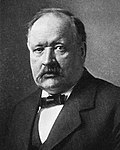 Svante Arrhenius
Partners
Children

Is this everyone?
Only relatives with a profile here are drawn, so a family can be larger than this. A line here can also be wrong.
Correct this familyAbout this person
Svante August Arrhenius was born in Sweden on 19 February 1859 and trained as a physicist, but his work bridged disciplines in ways that would define physical chemistry as a field. In 1903 he won the Nobel Prize in Chemistry, the first Swede to take home a Nobel in any category. Two years later he became director of the Nobel Institute and held the post until his death. His most prescient work applied physical chemistry to atmospheric science: he estimated how much warming could be expected from increased carbon dioxide in the air, laying groundwork that would become modern climate science. In the 1960s, Charles David Keeling's measurements confirmed CO₂ was climbing and that Arrhenius's greenhouse hypothesis could account for observable warming. He died on 2 October 1927, leaving his name on an equation, definitions of acids and bases, craters on the Moon and Mars, a mountain, and a laboratory at Stockholm University.



Fame.am measures public visibility signals. It does not measure human value, talent, morality, or credibility.