Shin'ichirō Tomonaga
Japanese physicist (1906-1979) · Japan · Scientists · Died at 73
Shin'ichirō Tomonaga is read about 324 times a day, in 75 languages.
A typical day, 30 days to 15 October 2026
The middle day of the days counted, so one week of news cannot move it. The line under it is the last 390 days, one point a day.
Something wrong?He shared the 1965 Nobel Prize in Physics for cracking quantum electrodynamics - the theory of how light and matter talk to each other at the smallest scale - work that reshaped how physicists understand elementary particles.
A life in dates
Also in Deutsch
Photos 6


In their own words 2
 ,
, Nature was not satisfied by a simple point charge but required a charge with spin.
...a bride who is bullied by her mother-in-law will herself become a bad mother-in-law.
Awards
In their orbit
 Father: Tomonaga Sanjūrō
About this person
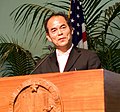
Born March 31, 1906, Tomonaga built his career as a physicist in Japan through the middle of the twentieth century. His fundamental work in quantum electrodynamics ran parallel to breakthroughs by Richard Feynman and Julian Schwinger, though each arrived by different routes. The three shared the 1965 Nobel Prize in Physics for contributions that carried deep consequences for elementary particle physics. He died July 8, 1979.


Fame.am measures public visibility signals. It does not measure human value, talent, morality, or credibility.