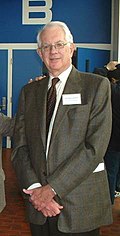
Sheldon Lee Glashow
American theoretical physicist · United States · Scientists · Born 1932 · age 93
Sheldon Lee Glashow is read about 121 times a day, in 68 languages.
Counted to 16 September 2026, not since.
The middle day of the days counted, so one week of news cannot move it. The line under it is the last 361 days, one point a day.
Something wrong?He helped prove that two of nature's fundamental forces - electromagnetism and the weak nuclear force - are secretly the same thing at high energies, a unification that earned him a third of the 1979 Nobel Prize in Physics.
A life in dates
Photos 6


.jpg?width=1200)


In their own words 8
 ,
, Why was there a Big Bang? What, if anything, came before? What mechanisms generated the exponential inflation of the early Universe?
... Why is the muon, some dumb particle, 200 times heavier than the electron? Why is the proton about 2,000 times heavier than the electron?
All kinds of questions remain. Many have to do with cosmology. How did the universe originate?
Awards
About this person
Born December 5, 1932, Sheldon Lee Glashow built his career in theoretical physics working on the deepest architecture of matter. Alongside Abdus Salam and Steven Weinberg, he developed the theory unifying weak and electromagnetic interactions between elementary particles, work that included predicting the weak neutral current before experiments confirmed it. The Nobel committee honored the trio in 1979. Glashow has held chairs at Harvard, where he's now an emeritus Eugene Higgins Professor of Physics, and currently teaches as the Metcalf Professor of Mathematics and Physics at Boston University. He also serves on the board of sponsors for the Bulletin of the Atomic Scientists.
In common with Sheldon
 Frederick ReinesBoth received J. Robert Oppenheimer Memorial Prize
 Giorgio ParisiBoth received High Energy and Particle Physics Prize
 John Archibald WheelerBoth received J. Robert Oppenheimer Memorial Prize
 Hugh David PolitzerBoth received High Energy and Particle Physics Prize
 Freeman DysonBoth received J. Robert Oppenheimer Memorial Prize
 Martinus J. G. VeltmanBoth received High Energy and Particle Physics Prize
Fame.am measures public visibility signals. It does not measure human value, talent, morality, or credibility.