Sergei Rachmaninoff
Russian composer, pianist and conductor (1873-1943) · United States · Musicians · Died at 69 · also Russia
Sergei Rachmaninoff is read about 3,590 times a day, in 76 languages.
A typical day, 30 days to 22 October 2026
The middle day of the days counted, so one week of news cannot move it. The line under it is the last 397 days, one point a day.
Something wrong?A pianist whose technical command was so absolute that his own compositions became the benchmark other players couldn't reach - and a composer who kept writing high Romantic music decades after the rest of Europe had moved on.
A life in dates
Also in Deutsch
Photos 7


In their own words 9
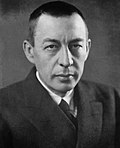 ,
I feel like a ghost wandering in a world grown alien. I cannot cast out the old way of writing and I cannot acquire the new.
A good conductor ought to be a good chauffeur; the qualities that make the one also make the other.
Especially dangerous on the musical front in the present class war.
Listen
SpotifyAlbums 24
 RMRachmaninov: The Bells (Choral Symphony) / Vocalise / Tchaikovsky: Romeo and Juliet Duo / Festival Coronation March
 TNTchaikovsky: Piano Concerto no. 1 / Rachmaninov: Piano Concerto no. 2RORachmaninov: Concerto pour piano no. 2, op. 18 / Grieg: Concerto pour piano, op. 16RNRachmaninov: Piano Concerto No. 2 / Prokofiev: Piano Concerto No. 5
Awards
Family
Parents
Sergei RachmaninoffPartners
Children
Is this everyone?
Only relatives with a profile here are drawn, so a family can be larger than this. A line here can also be wrong.
Correct this familyAbout this person
Born into a musical family in 1873, Rachmaninoff studied at the Moscow Conservatory and graduated in 1892 with compositions already behind him. The catastrophic premiere of his Symphony No. 1 in 1897 triggered a four-year depression during which he wrote almost nothing, until therapy unlocked Piano Concerto No. 2 in 1901. He conducted at the Bolshoi from 1904 to 1906, moved to Dresden, and launched his first American tour in 1909. After the Russian Revolution he left permanently, settling in New York in 1918 and spending the next decades touring as a concert pianist across the US and Europe, summering at his Swiss villa from 1932 onward. The performing life consumed him - he completed just six works after leaving Russia. In 1942, failing health brought him to Beverly Hills, where melanoma killed him in 1943.
In common with Sergei
 Sergei ProkofievBoth received Royal Philharmonic Society Gold Medal
 Arturo ToscaniniBoth received Royal Philharmonic Society Gold Medal
 Leonard BernsteinBoth received Royal Philharmonic Society Gold Medal
 Yehudi MenuhinBoth received Royal Philharmonic Society Gold Medal
 Jean SibeliusBoth received Royal Philharmonic Society Gold Medal
 Richard StraussBoth received Royal Philharmonic Society Gold Medal
Fame.am measures public visibility signals. It does not measure human value, talent, morality, or credibility.