Ludwig van Beethoven is read about 9,095 times a day, in 217 languages.
A typical day, 30 days to 15 October 2026
The middle day of the days counted, so one week of news cannot move it. The line under it is the last 390 days, one point a day.
Something wrong?He wrote some of the most performed music in history while going deaf. Beethoven bridged the Classical and Romantic eras, expanding the symphony and string quartet into forms that still dominate concert halls.
A life in dates
Also in Deutsch
Photos 12

 Beethoven's birthplace at Bonngasse 20 in Bonn is now the Beethoven-Haus museum.
 Ludwig van Beethoven baptismal document
![Silhouette image made of Beethoven "in his 16th year" (c. 1786; age 15). He wears the uniform and wig suited to his employment as a court musician in Bonn.[14]](https://upload.wikimedia.org/wikipedia/commons/thumb/3/3a/Silhouette_de_Beethoven_%C3%A0_16_ans.png/330px-Silhouette_de_Beethoven_%C3%A0_16_ans.png) Silhouette image made of Beethoven "in his 16th year" (c. 1786; age 15). He wears the uniform and wig suited to his employment as a court musician in Bonn.[14]
Silhouette image made of Beethoven "in his 16th year" (c. 1786; age 15). He wears the uniform and wig suited to his employment as a court musician in Bonn.[14]

![The earliest known portrait of Beethoven (age 29); engraving (c. 1801) by Johann Joseph Neidl after a now-lost portrait by Gandolph Ernst Stainhauser von Treuberg (c. 1800)[37]](https://upload.wikimedia.org/wikipedia/commons/thumb/1/12/Ludwig_van_Beethoven%2C_aged_twenty-six_%281796%29.jpg/1280px-Ludwig_van_Beethoven%2C_aged_twenty-six_%281796%29.jpg) The earliest known portrait of Beethoven (age 29); engraving (c. 1801) by Johann Joseph Neidl after a now-lost portrait by Gandolph Ernst Stainhauser von Treuberg (c. 1800)[37]
The earliest known portrait of Beethoven (age 29); engraving (c. 1801) by Johann Joseph Neidl after a now-lost portrait by Gandolph Ernst Stainhauser von Treuberg (c. 1800)[37] Prince Lobkowitz depicted in a portrait by August Friedrich Oelenhainz
In their own words 10
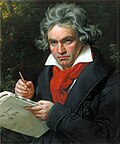 ,
, Plaudite, amici, comedia finita est. (Applaud, my friends, the comedy is over.)
The day-to-day exhausted me!
You will hear nothing of me here ... Fidelio? They cannot give it, nor do they want to listen to it. The symphonies? They have no time for them. My concertos?
Listen
SpotifyOn YouTube
227K subscribersAlbums 24
Awards
Family
Parents

 Ludwig van Beethoven
Brothers and sisters

Is this everyone?
Only relatives with a profile here are drawn, so a family can be larger than this. A line here can also be wrong.
Correct this familyAbout this person
Born in Bonn in 1770, Beethoven was drilled as a prodigy by his father before finding steadier ground with teacher Christian Gottlob Neefe and the von Breuning family. At 21 he moved to Vienna to study with Haydn, built a reputation as a virtuoso pianist, and by 1795 had published his first opus-numbered works. His career unfolded in three phases: early works in the classical mold of Haydn and Mozart, a middle period from 1802 to 1812 that produced the Eroica and Fifth Symphonies at unprecedented scale, and a late stretch of radical invention - the choral Ninth Symphony in 1824, the Hammerklavier, the Diabelli Variations, and string quartets that remain pinnacles of the form. He began losing his hearing around 1798 and died bedridden in Vienna in 1827, aged 56.
In common with Ludwig

Musicians from Germany 5




Fame.am measures public visibility signals. It does not measure human value, talent, morality, or credibility.