Saladin
Sultan of Egypt and founder of the Ayyubid dynasty (1137-1193) · Politicians · Lived 1138 to 1193 · aged 55
Saladin is read about 6,977 times a day, in 146 languages.
A typical day, 30 days to 15 October 2026
The middle day of the days counted, so one week of news cannot move it. The line under it is the last 390 days, one point a day.
Something wrong?He took Jerusalem from the Crusaders in 1187 and became the figure both sides of a religious war could admire. A Kurdish commander who rose through treachery and talent to found a dynasty, Saladin remains the most famous Kurd in history and one of the few medieval Muslim leaders the West never turned into a monster.
A life in dates
Also in Deutsch
Photos 12

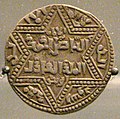
![Coin of Saladin, wearing Sasanian-style merlon crown,[29] dated AH 578 (AD 1182/3).[30]](https://upload.wikimedia.org/wikipedia/commons/thumb/b/bc/Coin_of_Saladin%2C_Nisibin_mint%2C_578_H_%28Obverse_and_reverse%29.jpg/1280px-Coin_of_Saladin%2C_Nisibin_mint%2C_578_H_%28Obverse_and_reverse%29.jpg) Coin of Saladin, wearing Sasanian-style merlon crown,[29] dated AH 578 (AD 1182/3).[30]
Coin of Saladin, wearing Sasanian-style merlon crown,[29] dated AH 578 (AD 1182/3).[30]![Ayyubid or Zengid soldiers in Seljuk-type clothes[36] and sharbush hats[37][38] on the Palmer Cup (1200-1215)[39]](https://upload.wikimedia.org/wikipedia/commons/thumb/0/0e/Palmer_cup_left_attendants_%28British_Museum%29.jpg/500px-Palmer_cup_left_attendants_%28British_Museum%29.jpg) Ayyubid or Zengid soldiers in Seljuk-type clothes[36] and sharbush hats[37][38] on the Palmer Cup (1200-1215)[39]
Ayyubid or Zengid soldiers in Seljuk-type clothes[36] and sharbush hats[37][38] on the Palmer Cup (1200-1215)[39] Saladin's battles in Egypt
![Experimental crossbow mounted inside a shield, in the Tabṣira by Murḍi Ibn cālī Ibn Murḍi al-Ṭarsūsī written for Saladin, late Fāṭimid or early Ayyūbid Egypt, c. 1170 CE (Ms. Hunt.264, f.117, Bodleian Library, Oxford, UK).[45]](https://upload.wikimedia.org/wikipedia/commons/thumb/f/f0/Experimental_crossbow_mounted_inside_a_shield%2C_in_the_Tab%E1%B9%A3ira_by_Mur%E1%B8%8Di_Ibn_c%C4%80l%C4%AB_Ibn_Mur%E1%B8%8Di_al-%E1%B9%ACars%C5%ABs%C4%AB_written_for_Saladin%2C_late_F%C4%81%E1%B9%ADimid_or_early_Ayy%C5%ABbid_Egypt%2C_c.1170_CE_%28Ms._Hunt.264%2C_f.117%2C_Bodleian_Library%2C_Oxford%2C_UK%29.jpg/1280px-thumbnail.jpg) Experimental crossbow mounted inside a shield, in the Tabṣira by Murḍi Ibn cālī Ibn Murḍi al-Ṭarsūsī written for Saladin, late Fāṭimid or early Ayyūbid Egypt, c. 1170 CE (Ms. Hunt.264, f.117, Bodleian Library, Oxford, UK).[45]
Experimental crossbow mounted inside a shield, in the Tabṣira by Murḍi Ibn cālī Ibn Murḍi al-Ṭarsūsī written for Saladin, late Fāṭimid or early Ayyūbid Egypt, c. 1170 CE (Ms. Hunt.264, f.117, Bodleian Library, Oxford, UK).[45]![Ayyubid expansion 1174-1193, including the campaigns of Saladin, Qaraqush (nephew of Saladin) and Turan-Shah (elder brother of Saladin).[61]](https://upload.wikimedia.org/wikipedia/commons/thumb/0/05/Ayyubid_expansion_1174-1193.png/1280px-Ayyubid_expansion_1174-1193.png) Ayyubid expansion 1174-1193, including the campaigns of Saladin, Qaraqush (nephew of Saladin) and Turan-Shah (elder brother of Saladin).[61]
Ayyubid expansion 1174-1193, including the campaigns of Saladin, Qaraqush (nephew of Saladin) and Turan-Shah (elder brother of Saladin).[61] 19th-century depiction of a victorious Saladin, by Gustave Doré
 Saladin ended his siege of the Ismaili ("Assassins") fortress of Masyaf, which was commanded by Rashid ad-Din Sinan, under uncertain circumstances in August 1176.
In their own words 4
 ,
, This Yemen is a treasure house...We conquered it, but up to this day we have had no return and no advantage from it.
I thought of thee, amid the thrusting of their spears, While the straight browned blades quenched their thirst in our blood - ...
This is a victory opening the gates of men’s hearts.
Family
Parents
 Saladin
Partners
Children

Brothers and sisters


Is this everyone?
Only relatives with a profile here are drawn, so a family can be larger than this. A line here can also be wrong.
Correct this familyAbout this person
Born around 1137, Saladin went to Egypt in 1164 as part of his uncle Shirkuh's mercenary contingent serving the Zengid dynasty, originally to reinstall a vizier for the teenage Fatimid caliph. After his uncle died in 1169, Saladin became vizier himself, then quietly dismantled the Shia Fatimid Caliphate from within and realigned Egypt with the Sunni Abbasid Caliphate in 1171. He seized Syria after his Zengid patron died in 1174, taking Damascus peacefully and defeating rival Zengid lords at the Battle of the Horns of Hama in 1175, becoming sultan of Egypt and Syria. His Ayyubid army shattered the Crusaders at Hattin in 1187 and retook Jerusalem, ending Christian military dominance in the Levant. He died in Damascus in 1193 having given most of his wealth away, and was buried beside the Umayyad Mosque.


._Hafiz-i_Abru's_Majma_al-Tawarikh_(The_Assembly_of_History)._Timurid_Persia%2C_Herat%2C_circa_1425.jpg?width=120)
Fame.am measures public visibility signals. It does not measure human value, talent, morality, or credibility.