Rudolf Virchow
German doctor, anthropologist, public health activist, pathologist, prehistorian, biologist and politician (1821-1902) · Doctors · Died at 80
Rudolf Virchow is read about 655 times a day, in 62 languages.
A typical day, 30 days to 15 October 2026
The middle day of the days counted, so one week of news cannot move it. The line under it is the last 390 days, one point a day.
Something wrong?He coined "Omnis cellula e cellula" - all cells come from cells - a cornerstone of modern biology, though he lifted it from a colleague. The same man who named leukemia and thrombosis rejected germ theory, called Darwin an ignoramus, and survived a duel challenge from Bismarck.
A life in dates
Also in Deutsch
Photos 8
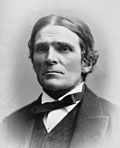
 Rudolf Ludwig Karl Virchow. Photograph by J. C. Schaarwächte Wellcome V0027292
 Allegory of Medicine, for Rudolf Virchow on his 70th birthday, by Anton Scharff and Karl Waschmann, 1891 - Bode-Museum - DSC02847
 Allgemeine Poliklinik - Virchow, Vienna, 2019
 Berolina 02 11 1881
 Bruno Kruse - Plakette zum 80. Geburtstag Rudolf Virchows, 1901
%2C_Sep_2019.jpg?width=1200) Busts of Becker and Virchow (Jose Rizal Park, Wilhelmsfeld), Sep 2019
Busts of Becker and Virchow (Jose Rizal Park, Wilhelmsfeld), Sep 2019 Busts of Becker and Virchow at Rizal Park in Wilhelmsfeld, Germany
 Cancroid from a tumour of the underlip Wellcome L0006416
In their own words 7
 ,
, Between animal and human medicine, there is no dividing line - nor should there be.
For if medicine is really to accomplish its great task, it must intervene in political and social life.
The task of science is to stake out the limits of the knowable, and to center consciousness within them.
Awards
Family
Parents
Rudolf VirchowPartners

Children


Is this everyone?
Only relatives with a profile here are drawn, so a family can be larger than this. A line here can also be wrong.
Correct this familyAbout this person
Rudolf Virchow studied medicine in Berlin under Johannes Peter Müller, and while working at Charité hospital investigated the 1847-1848 typhus epidemic in Upper Silesia - work that became the foundation for public health in Germany and led him to declare that "medicine is a social science, and politics is nothing else but medicine on a large scale." His role in the Revolution of 1848 got him expelled from Charité; he spent seven years at Würzburg before the hospital brought him back to lead a new pathology institute in 1856. Over 2,000 scientific writings followed, including Cellular Pathology in 1858, and he named diseases from leukemia to thrombosis, coined terms like "neuroglia" and "amyloid degeneration", pioneered systematic autopsy, and brought hair analysis into forensic work. He co-founded political parties, sat in the Prussian parliament and the Reichstag, backed Bismarck's Kulturkampf against the Catholic Church, and spent his final decades rejecting germ theory, dismissing Darwin, and insisting the first Neanderthal skull belonged to a deformed human. His colleagues called him the Pope of medicine.



Fame.am measures public visibility signals. It does not measure human value, talent, morality, or credibility.