Rudolf Clausius
German mathematical physicist and professor (1822-1888) · Scientists · Died at 66
Rudolf Clausius is read about 246 times a day, in 70 languages.
A typical day, 30 days to 15 October 2026
The middle day of the days counted, so one week of news cannot move it. The line under it is the last 390 days, one point a day.
Something wrong?He gave entropy its name and the second law of thermodynamics its first clear statement - the conceptual architecture that governs every engine, every star, every system sliding toward disorder.
A life in dates
Also in Deutsch
Photos 8
 Clausius
 Clausius coins entropy
 Clausius integral
 Clausius Rudolf
 Clausius, Rudolf - Abhandlungen über die Anwendung der mechanischen Wärmetheorie auf die elektrischen Erscheinungen, 1898 - BEIC 6830494
 Clausius-1
 Das Fotoalbum für Weierstraß 2 4 (Rudolf Clausius)
 Die Energie der Welt ist constant. Die Entropie der Welt strebt einem Maximum (1865)
In their own words 10
 ,
My memoirs "On the Mechanical Theory of Heat" are of different kinds.
Theorem of the equivalence of Heat and Work.
The s... may be divided into two classes: those which the atoms of a body exert upon each other... which depend...
Awards
Family
Rudolf ClausiusPartners
Children
Is this everyone?
Only relatives with a profile here are drawn, so a family can be larger than this. A line here can also be wrong.
Correct this familyAbout this person
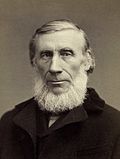
Rudolf Julius Emanuel Clausius was born in Prussia on 2 January 1822, trained as a physicist and mathematician, and spent his career rewriting the theory of heat from principle up. In 1850 he published "On the Moving Force of Heat," which first articulated the basic ideas of what became the second law of thermodynamics, rescuing and refining Sadi Carnot's earlier work on the Carnot cycle. Fifteen years later, in 1865, he coined the term entropy to describe the measure of disorder that can never decrease in a closed system. In 1870 he introduced the virial theorem, extending his methods to the behavior of heat in dynamic systems. He died on 24 August 1888, having laid the conceptual foundation for much of modern physics.
In common with Rudolf

Scientists born in the 1820s 5



Fame.am measures public visibility signals. It does not measure human value, talent, morality, or credibility.