Roger Bacon
English polymath, philosopher and friar (c.1219/20-c.1292) · United Kingdom · Academics · Lived 1220 to 1292 · aged 72
Roger Bacon is read about 714 times a day, in 72 languages.
A typical day, 30 days to 15 October 2026
The middle day of the days counted, so one week of news cannot move it. The line under it is the last 390 days, one point a day.
Something wrong?A 13th-century friar who pushed for testing ideas against the physical world instead of just reading Aristotle - and later got remembered as a wizard who built a talking brass head.
Also in Deutsch
Photos 8
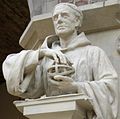
 Roger-bacon-statue
 (S. Clerestory 1) Science Window
 A new and complete illustration of the occult sciences- or Fleuron T196383-49
 An archangel revealing the physical nature of the universe t Wellcome L0022460
 Augenbild by Roger Bacon Wellcome L0010717
 Bacon 1867
 Bacon, Roger CIPA0464
 Bacons Argument gegen die aktuale Unendlichkeit
In their own words 10
 ,
Oh how delightful is the taste of wisdom to those who are thus steeped in it from its very fount and origin.
Everything in nature completes its action through its own force and species alone... as, for example, fire by its own force dries and consumes and does many things.
I shall draw... a figure (which all these matters are made clear as far as possible on a surface, but the full demonstration would require a body like the eye...
About this person
Roger Bacon, born around 1219 in England, became a Franciscan friar who thought Catholic faith and hands-on observation belonged together. He read the work of Ibn al-Haytham and noticed that running experiments sometimes proved Aristotle wrong, a method he learned partly from his teacher Robert Grosseteste. In 1267 he sent his Opus Majus to Pope Clement IV, a sprawling argument for empirical study that helped get optics added to university courses. He also wrote down Europe's first recorded formula for gunpowder, borrowed from Chinese sources. He worked on universal grammar and died around 1292, but by the early modern period the legend had shifted: people started calling him Doctor Mirabilis and spinning tales of necromancy and mechanical heads.
Academics from the United Kingdom 6


Fame.am measures public visibility signals. It does not measure human value, talent, morality, or credibility.