Richard Adolf Zsigmondy
Austrian chemist (1865-1929) · Austria · Scientists · Died at 64
Richard Adolf Zsigmondy is read about 35 times a day, in 65 languages.
A typical day, 30 days to 15 October 2026
The middle day of the days counted, so one week of news cannot move it. The line under it is the last 83 days, one point a day.
Something wrong?He made the invisible visible. Zsigmondy's ultramicroscope let scientists see particles too small for any lens before it - work that cracked open colloid chemistry and earned him the 1925 Nobel Prize.
Also in Deutsch
Photos 8
 Richard Adolf Zsigmondy LOC
 Richard Zsigmondy
 Richard Adolf Zsigmondy, Eger
 Göttingen Stadtfriedhof Richard Adolf Zsigmondy
 Grave of Richard Zsigmondy at Stadtfriedhof Göttingen 2017 01
_1900_barcode_910000105539.jpg?width=1200) Portret van Richard Zsigmondy (reproductie) 1900 barcode 910000105539
Portret van Richard Zsigmondy (reproductie) 1900 barcode 910000105539 Prof. Richard Zsigmondy LCCN2014709680
 Richard Adolf Zsigmondy
Awards
Family
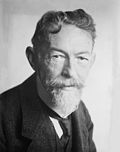 Richard Adolf Zsigmondy
Brothers and sisters


Is this everyone?
Only relatives with a profile here are drawn, so a family can be larger than this. A line here can also be wrong.
Correct this familyAbout this person
Richard Adolf Zsigmondy was born 1 April 1865, Austrian by birth but Hungarian by name. His research centered on colloids - those strange suspensions of particles neither dissolved nor settled - a realm where chemistry blurred into physics and nothing behaved as expected. To study what couldn't be seen, he co-invented the slit-ultramicroscope, an instrument that used scattered light to reveal particles beyond the reach of ordinary optics. The work opened a field. In 1925 the Nobel committee in Chemistry gave him the prize for it. He also developed membrane filters that became standard tools. Zsigmondy died 23 September 1929; a crater on the Moon now carries his name.


Fame.am measures public visibility signals. It does not measure human value, talent, morality, or credibility.