Pierre Beaumarchais
French playwright, diplomat and polymath (1732-1799) · France · Writers · Died at 67
Pierre Beaumarchais is read about 479 times a day, in 60 languages.
A typical day, 30 days to 15 October 2026
The middle day of the days counted, so one week of news cannot move it. The line under it is the last 390 days, one point a day.
Something wrong?He wrote the plays that became *The Barber of Seville* and *The Marriage of Figaro*, but spent more of his life as a watchmaker, spy, and arms dealer - funneling French guns to American rebels years before his government officially joined the war.
Also in Deutsch
Photos 8
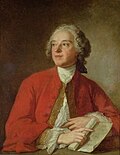
_-001.jpg?width=1200) D'après Jean-Marc Nattier, Portrait de Pierre-Augustin Caron de Beaumarchais (Bibliothèque-musée de la Comédie-Française) -001
D'après Jean-Marc Nattier, Portrait de Pierre-Augustin Caron de Beaumarchais (Bibliothèque-musée de la Comédie-Française) -001_btv1b69421280.jpg?width=1200) Beaumarchais nu-tête la main gauche (...) btv1b69421280
Beaumarchais nu-tête la main gauche (...) btv1b69421280 DeBeaumarchais
 Desenne Ashby La mère coupable Beaumarchais détail
 Jean-Baptiste-François Génillion La maison de Beaumarchais et la Bastille
 Jean-Honoré Fragonard Anne-Pauline Le Breton
 Marie-Thérèse de Beaumarchais née Villermaula 1751-1816
.jpg?width=1200) P. A Caron de Beaumarchais. G.3487 (1 of 2)
P. A Caron de Beaumarchais. G.3487 (1 of 2)In their own words 5
 ,
, Edward J. Lowell, The Eve of the French Revolution (Houghton Mifflin Co, 1892) p. 327
Thomas Benfield Harbottle and Philip Hugh Dalbiac, Dictionary of Quotations: French and Italian, 2nd ed. (1904) pp. 10, 13, 63, 101, 118, 143, 149, 235
W. Francis H. King, Classical and Foreign Quotations, 3rd ed. (1904) nos. 241, 278, 1014, 1032, 1180, 1321, 1505, 1538, 2532, 3000
Family
Pierre BeaumarchaisPartners

Is this everyone?
Only relatives with a profile here are drawn, so a family can be larger than this. A line here can also be wrong.
Correct this familyAbout this person
Born to a Parisian watchmaker on 24 January 1732, Pierre-Augustin Caron added "de Beaumarchais" as he climbed into the court of Louis XV, where he worked as an inventor and music teacher. The contacts he made there launched him into diplomacy, espionage, and business ventures that built a fortune - then nearly destroyed it in costly legal fights. When the American colonists rebelled, Beaumarchais became an early French advocate for their cause, lobbying his government and personally overseeing covert shipments of arms and money from France and Spain starting years before the 1778 alliance. He sank his own funds into the operation and spent decades trying to recover them. He lived to see the French Revolution begin in 1789, joined its early stages, and died in Paris on 18 May 1799.


Fame.am measures public visibility signals. It does not measure human value, talent, morality, or credibility.