Otto Hahn
German chemist and physicist (1879-1968) · Germany · Scientists · Died at 89
Otto Hahn is read about 694 times a day, in 87 languages.
A typical day, 30 days to 20 October 2026
The middle day of the days counted, so one week of news cannot move it. The line under it is the last 395 days, one point a day.
Something wrong?The chemist who split the atom - and collected a Nobel Prize alone for work done with a partner who had to flee Nazi Germany. Hahn's 1938 discovery of nuclear fission opened the age of reactors and bombs, but the recognition never included Lise Meitner, the physicist beside him when the breakthrough came.
A life in dates
Also in Deutsch
Photos 8
.jpg?width=1200) Otto Hahn (Nobel)
Otto Hahn (Nobel) 12. Tagung 1962 Physik; Bayrisches Frühstück Otto Hahn, L. Meitner - W134Nr.069602a - Willy Pragher
 12. Tagung 1962 Physik; Bayrisches Frühstück Otto Hahn, L. Meitner - W134Nr.069602b - Willy Pragher
 12. Tagung 1962 Physik; Bayrisches Frühstück Otto Hahn, L. Meitner - W134Nr.069602d - Willy Pragher
 12. Tagung 1962 Physik; Bayrisches Frühstück- Otto Hahn, Graf Lennart Bernadotte, L. Meitner - LABW - Staatsarchiv Freiburg W 134 Nr. 069602e
 15. Tagung 1965 Physiker; Maikäferrede- Otto Hahn, M. Heinlein - LABW - Staatsarchiv Freiburg W 134 Nr. 079007a
 15. Tagung 1965 Physiker; Maikäferrede- Otto Hahn, M. Heinlein - LABW - Staatsarchiv Freiburg W 134 Nr. 079007b
 15. Tagung 1965 Physiker; Maikäferrede- Otto Hahn, Werner Heisenberg, Richard Kuhn, hinten- Sir John D. Cockcroft - LABW - Staatsarchiv Freiburg W 134 Nr. 078969
In their own words 4
 ,
, In postwar Germany, Otto Hahn became the most revered elder statesman of what had once been Europe's proudest scientific establishment.
Professor Meitner stated that nuclear fission could be attributed to chemistry. I have to make a slight correction.
Otto Hahn is a figure of world history. But he possesses none of the attributes of the traditional luminaries in history books.
Awards
Family
Otto HahnPartners


Is this everyone?
Only relatives with a profile here are drawn, so a family can be larger than this. A line here can also be wrong.
Correct this familyAbout this person
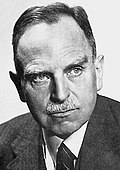
Born 8 March 1879, Hahn earned his doctorate from the University of Marburg in 1901, then trained under William Ramsay in London and Ernest Rutherford in Montreal, discovering new radioactive isotopes. Back in Germany by 1906, he set up in a basement woodworking shop at the University of Berlin and began a decades-long collaboration with Austrian physicist Lise Meitner. Between 1934 and 1938, working with Fritz Strassmann, they bombarded uranium with neutrons - the experiments that revealed nuclear fission. Meitner, Jewish, fled Germany in 1938; Hahn stayed, catalogued fission products during the war for the German nuclear program, and in 1944 received the Nobel alone. After Allied detention at Farm Hall, he spent his final decades rebuilding German science: last president of the Kaiser Wilhelm Society, founding president of the Max Planck Society from 1948 to 1960, and co-founder of the Federation of German Scientists in 1959. He died 28 July 1968, one of post-war Germany's most respected voices for responsible science.



Fame.am measures public visibility signals. It does not measure human value, talent, morality, or credibility.