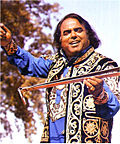
Nusrat Fateh Ali Khan
Pakistani musician, primarily a singer of qawwali (1948-1997) · Pakistan · On the map · Musicians · Died at 48
He took a devotional form sung for centuries in Sufi shrines and made it electrify rock festivals and film soundtracks from Tokyo to London. His voice - vast, agile, capable of hours at full intensity - turned qawwali into a global lingua franca before most of the West knew the word.
Nusrat Fateh Ali Khan is read about 1,819 times a day, in 58 languages.
A typical day, 30 days to 16 November 2026
The middle day of the days counted, so one week of news cannot move it. The line under it is the last 400 days, one point a day.
Something wrong?People around Nusrat



Is this everyone?
Only relatives with a profile here are drawn, so a family can be larger than this. A line here can also be wrong.
Correct this familyAlbums 24
 CLChain of Light
 NVNusrat Fateh Ali Khan, Vol. 2
 REReformed
 RKRemembering The Legendary Nusrat Fateh Ali Khan
Media & music
Listen
Spotify


Awards
About this person
Born in West Punjab in 1948, Nusrat Fateh Ali Khan made his first public performance at 15, at his father's chelum. By 1971 he'd become head of the family qawwali party, weaving his own techniques - sargam, khayal, a driving sense of rhythm - into a centuries-old tradition. An early-80s signing with Birmingham's Oriental Star Agencies opened the door: he began releasing albums and film scores across Europe, India, Japan, Pakistan, and the United States, collaborating with Western artists and touring over 40 countries. The man NPR named one of the 50 Great Voices and Rolling Stone placed among the 200 greatest singers ever didn't just export qawwali - he rewired the DNA of Pakistani pop, Indian pop, and Bollywood music, all while remaining a master of Hindustani classical forms. He died in 1997, sixteen years after the world started listening.