Neville Chamberlain
Prime Minister of the United Kingdom from 1937 to 1940 · United Kingdom · Politicians · Lived 1869 to 1940 · aged 71
Neville Chamberlain is read about 2,875 times a day, in 95 languages.
A typical day, 30 days to 15 October 2026
The middle day of the days counted, so one week of news cannot move it. The line under it is the last 390 days, one point a day.
Something wrong?The British prime minister who believed he could bargain with Hitler. Chamberlain signed the Munich Agreement in September 1938, handing the Sudetenland to Nazi Germany in exchange for what he called peace - a miscalculation that turned his name into shorthand for the cost of appeasing tyrants.
A life in dates
Also in Deutsch
Photos 8
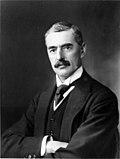
 Right Honourable Neville Chamberlain. Wellcome M0003096
 (24-8-31, près du 10 Downing Street) crise anglaise (de gauche à droite) Neville Chamberlain, Baldwin - btv1b53248563g
 (De gauche à droite) Neville Chamberlain, Baldwin - btv1b53247770z
 19-4-32, M. et Mme Neville Chamberlain (CN) - btv1b53255051j
 19-4-32, Neville Chamberlain et Mme, quitte son domicile et se rend aux Communes (CN) - btv1b532550520
 Bundesarchiv Bild 183-R99301, Münchener Abkommen, Chamberlain, Mussolini, Ciano

 Bundesarchiv Bild 146-1972-001-03, Münchener Abkommen, Chamberlain, Hitler
In their own words 10
 ,
In spite of the harshness and ruthlessness I thought I saw in his face, I got the impression that here was a man who could be relied upon when he had given his word.
Is it not positively horrible to think that the fate of hundreds of millions depends on one man, and he is half mad?
We pass no judgment here upon the political systems of other countries, but neither Fascism nor Communism is in harmony with our temperament and creed.
Awards
Family
Parents
 Neville Chamberlain
Partners

Children
Brothers and sisters


Is this everyone?
Only relatives with a profile here are drawn, so a family can be larger than this. A line here can also be wrong.
Correct this familyAbout this person
Chamberlain came to Parliament late, at 49, after years in business and local government, following his father and half-brother into politics in 1918. He rose quickly through ministerial posts - Health, then Chancellor of the Exchequer - before becoming prime minister on 28 May 1937. His tenure was consumed by the question of Germany's aggression, and Munich made him briefly popular at home. When Hitler invaded Poland on 1 September 1939, Chamberlain declared war two days later but delivered little real help during the "Phoney War." The failed defense of Norway in May 1940 shattered confidence in his leadership; after a brutal Commons debate stripped his majority, he resigned on 10 May, making way for Churchill. He stayed in the war cabinet as Lord President until cancer forced him out on 22 September. He died six weeks later, on 9 November 1940, his reputation already in ruins - blamed by Guilty Men and later historians for misjudging Hitler, though some now argue Britain wasn't ready for war in 1938.
Politicians from the United Kingdom 6



Fame.am measures public visibility signals. It does not measure human value, talent, morality, or credibility.