Muammar Gaddafi
Military officer and former Brotherly Leader and Guide of the Revolution of Libya (1969-2011) · Politicians · Lived 1942 to 2011 · aged 69
Muammar Gaddafi is read about 9,475 times a day, in 146 languages.
A typical day, 30 days to 15 October 2026
The middle day of the days counted, so one week of news cannot move it. The line under it is the last 390 days, one point a day.
Something wrong?He ruled Libya for forty-two years through a system he called direct democracy while retaining absolute personal power, nationalized the oil industry to fund both domestic programs and foreign militants, and died at the hands of rebel forces after NATO intervention ended his government in 2011.
A life in dates
Also in Deutsch
Photos 12
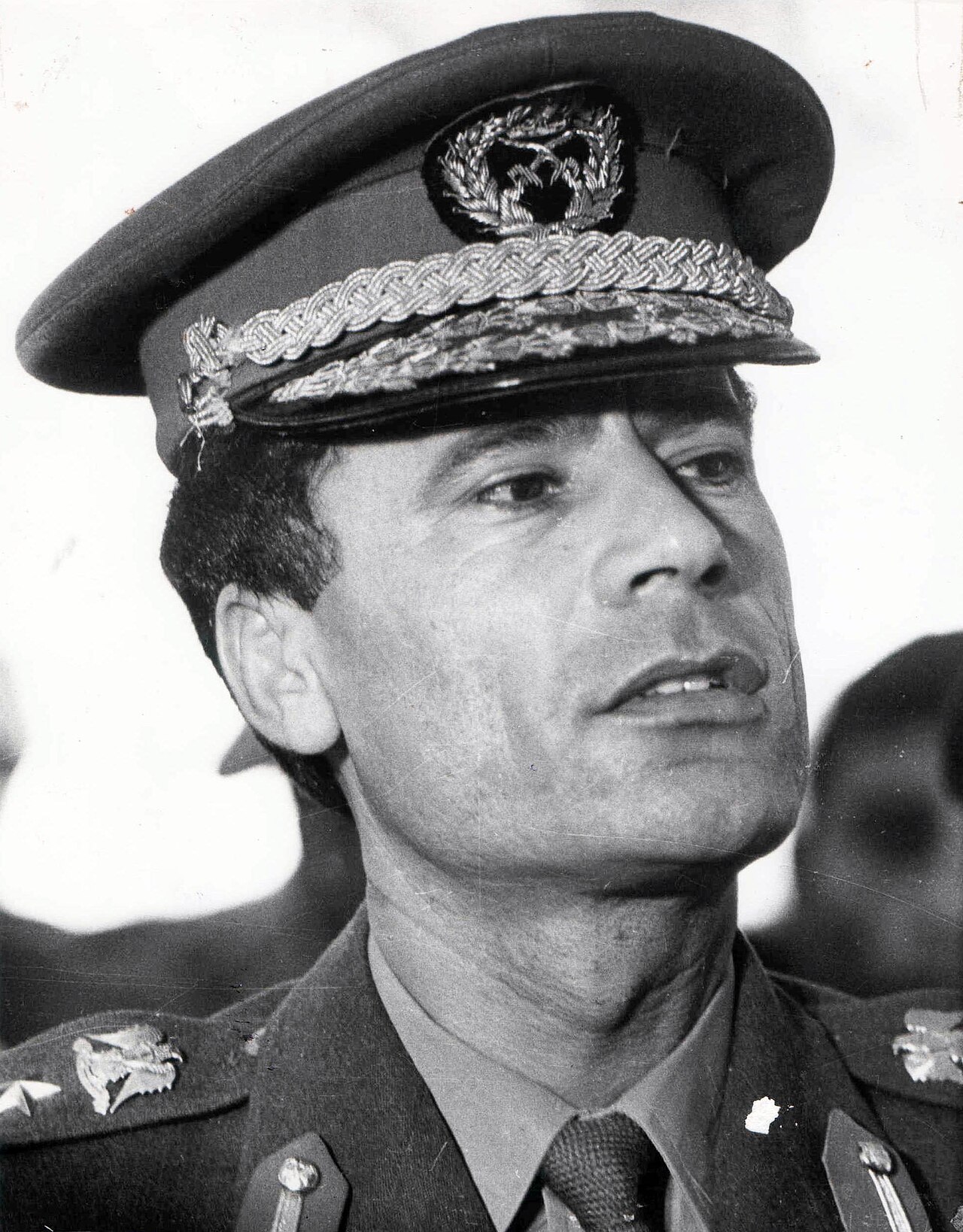

 Egyptian President Nasser was Gaddafi's political hero.
 The flag of republican Libya used by Gaddafi's government from 1969 to 1972
 Gaddafi at an Arab summit in Libya in 1969, shortly after the September Revolution that toppled King Idris I. Gaddafi sits in military uniform in the middle, surrounded by Egyptian President Gamal Abdel Nasser (left) and Syrian President Nureddin al-Atassi (right).
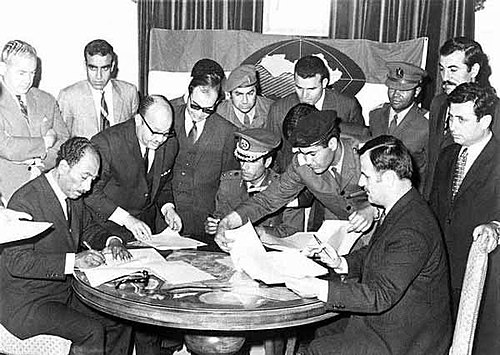 In 1971, Egypt's Anwar Sadat, Libya's Gaddafi and Syria's Hafez al-Assad signed an agreement to form a federal Union of Arab Republics. The agreement never materialized into a federal union between the three Arab states.
 Gaddafi (left) with Egyptian President Nasser in 1969. Nasser privately described Gaddafi as "a nice boy, but terribly naïve".[121]
 Gaddafi with Romanian President Nicolae Ceaușescu in Bucharest, 1974
In their own words 10
 ,
When I met Nasser, he said to me, "I see myself when I was young in you. You are the future for the Arab revolution." This meant very, very much to me.
Lincoln was a man who created himself from nothing without any help from outside or other people. I followed his struggles. I see certain similarities between him and me.
We [Libyans] support the Palestinian resistance, and all the world supports this. We support their just cause, but we are against terrorism.
Awards
Family
Parents
Muammar GaddafiPartners

Children


Is this everyone?
Only relatives with a profile here are drawn, so a family can be larger than this. A line here can also be wrong.
Correct this familyAbout this person
Gaddafi came to power in 1969 through a bloodless coup that toppled the Western-backed monarchy, converting Libya into a republic ruled by his Revolutionary Command Council. He expelled the Italian population, closed foreign military bases, and nationalized oil - using the revenues for housing, healthcare, education, and to bankroll revolutionaries abroad. In 1973 he launched a "Popular Revolution" with Basic People's Congresses, then in 1977 transformed the state into a Jamahiriya, taking a symbolic role while keeping control of the military and the Revolutionary Committees that suppressed dissent. Border wars with Egypt and Chad, support for militants, and alleged responsibility for the Pan Am 103 and UTA 772 bombings isolated Libya internationally, drawing U.S. airstrikes in 1986 and UN sanctions. After 1999 he pivoted from pan-Arabism to pan-Africanism and sought rapprochement with the West, chairing the African Union from 2009 to 2010. When protests erupted in eastern Libya in 2011, the situation became civil war; NATO intervened, his government fell, and he was captured in Sirte and killed by NTC militants on 20 October 2011.


Fame.am measures public visibility signals. It does not measure human value, talent, morality, or credibility.