Michael Faraday
British scientist (1791-1867) · United Kingdom · Scientists · Died at 75
Michael Faraday is read about 2,349 times a day, in 156 languages.
A typical day, 30 days to 17 October 2026
The middle day of the days counted, so one week of news cannot move it. The line under it is the last 392 days, one point a day.
Something wrong?He saw the invisible: magnetic fields, lines of force threading through space, the hidden scaffold holding light and electricity together. A self-taught bookbinder who never learned trigonometry, Faraday laid the groundwork for the electric motor and every theory of electromagnetism that followed.
A life in dates
Also in Deutsch
Photos 8
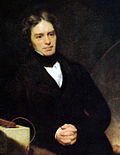
 M Faraday Th Phillips oil 1842
 'Faraday at work in his laboratory at the Royal Institution'. Wellcome M0004586
 'Faraday's laboratory'. Wellcome M0014433
 A large group of British inventors, politicians and military Wellcome V0006744
 Belgique - Louvain-la-Neuve - Parking des Sciences - Michael Faraday
 Caricature; Faraday giving his card to Father Thames. Wellcome M0012507
 Czech anaesthetic exhibition, Prague, May 1948. Wellcome M0010590
 Delineation of Lines of Magnetic Force by Iron filings
In their own words 10
 ,
I am, I hope, very thankful that in the withdrawal of the powers and things of life, the good hope is left with me, which makes the contemplation of death a comfort - not a fear.
There is no more open door by which you can enter into the study of natural philosophy than by considering the physical phenomena of a candle.
I am no poet, but if you think for yourselves, as I proceed, the facts will form a poem in your minds.
Awards
Family
Parents
Michael FaradayPartners
Is this everyone?
Only relatives with a profile here are drawn, so a family can be larger than this. A line here can also be wrong.
Correct this familyAbout this person
Born 22 September 1791, Faraday received little formal education and worked as a bookbinder before becoming one of history's most influential scientists. He thought visually rather than in symbols, his mathematics limited to simple algebra, yet he established the concept of the electromagnetic field and discovered the principles underlying electromagnetic induction, diamagnetism, and electrolysis. His inventions of electromagnetic rotary devices formed the foundation of electric motor technology, making electricity practical for use in technology. As a chemist, he discovered benzene and carbon tetrachloride, invented an early form of the Bunsen burner, and popularised terms like "anode," "cathode," and "ion." He became the first Fullerian Professor of Chemistry at the Royal Institution, devoted time to public service - investigating colliery explosions, industrial pollution, the Great Stink of the Thames - and refused to develop chemical weapons for the Crimean War, citing ethical reservations. James Clerk Maxwell translated his visual intuitions into equations that became the basis of all modern electromagnetic theory, writing that Faraday was "in reality a mat
Scientists from the United Kingdom 6


Fame.am measures public visibility signals. It does not measure human value, talent, morality, or credibility.