He dismantled every sacred claim - state, church, morality, even "humanity" itself - and said the only thing that mattered was the individual ego owning its own desires without apology. The Ego and Its Own landed in 1844 like a philosophical hand grenade, and it still hasn't stopped rolling.
A life in dates
Also in Deutsch
Photos 7

 Stirner's birthplace in Bayreuth
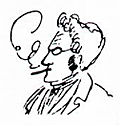
 Stirner, here depicted by Engels in 1842 standing, smoking and laying a hand on a table, was a member of the short-lived Young Hegelian group known as Die Freien.


 Posthumous sketch of Stirner by Engels for Mackay's 1892 biography, the second of the two surviving portraits of Stirner[1]
 Benjamin Tucker, pioneer of individualist anarchism
In their own words 10
 ,
Because our time is struggling toward the word with which it may express its spirit, many names come to the fore and all make claim to being the right one.
It is truly not the merit of the school if we do not come out selfish.
In the pedagogical as in certain other spheres freedom is not allowed to erupt, the power of the opposition is not allowed to put a word in edgewise: they want submissiveness.
In their orbit
About this person
Born Johann Caspar Schmidt in Bayreuth in 1806, he lost his father early and grew up in West Prussia after his mother remarried. He studied at the University of Berlin, sitting in on Hegel's lectures, then drifted into teaching and the Young Hegelians' late-night arguments. He never landed a permanent academic post, so he kept teaching on the side while writing. In 1844 he published The Ego and Its Own under the pen name Max Stirner - a book that torched every collective ideal and declared the self sovereign. He married twice: first to Agnes Burtz, who died in 1838, then to Marie Dähnhardt. A failed business venture left him broke, and he spent his last years translating and writing in near-obscurity. He died in Berlin in 1856, largely forgotten, though his radical individualism would later seed nihilism, existentialism, and anarchist thought.


Fame.am measures public visibility signals. It does not measure human value, talent, morality, or credibility.