Max Born
German-Jewish physicist and mathematician (1882-1970) · United Kingdom · Scientists · Died at 87
Max Born is read about 1,207 times a day, in 100 languages.
A typical day, 30 days to 15 October 2026
The middle day of the days counted, so one week of news cannot move it. The line under it is the last 390 days, one point a day.
Something wrong?He gave quantum mechanics its statistical backbone: the interpretation that a particle's wavefunction describes probabilities, not certainties - a reading so foundational it took nearly three decades to win him the Nobel Prize.
A life in dates
Also in Deutsch
Photos 8
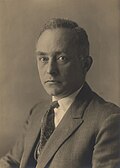
 Max Born
 15. Tagung 1965 Physiker; Maikäferrede- Rudolf L. Mößbauer, Max Born - LABW - Staatsarchiv Freiburg W 134 Nr. 078961a
 15. Tagung 1965 Physiker; Maikäferrede- Rudolf L. Mößbauer, Otto Hahn, Max Born - LABW - Staatsarchiv Freiburg W 134 Nr. 078956a
 15. Tagung 1965 Physiker; Maikäferrede- Rudolf L. Mößbauer, Otto Hahn, Max Born - LABW - Staatsarchiv Freiburg W 134 Nr. 078956b
_bw.jpg?width=1200) Solvay conference 1927 (group photograph) bw
Solvay conference 1927 (group photograph) bw_with_frame.jpg?width=1200) Solvay conference 1927 (group photograph) with frame
Solvay conference 1927 (group photograph) with frame.jpg?width=1200) Solvay conference 1927 (group photograph)
Solvay conference 1927 (group photograph) Solvay conference 1927 restored source
In their own words 10
 ,
, The belief that there is only one truth and that oneself is in possession of it, seems to me the deepest root of all that is evil in the world.
I am now convinced that theoretical physics is actually philosophy.
Intellect distinguishes between the possible and the impossible; reason distinguishes between the sensible and the senseless. Even the possible can be senseless.
Awards
Family
Parents
 Max Born
Partners
Children
Is this everyone?
Only relatives with a profile here are drawn, so a family can be larger than this. A line here can also be wrong.
Correct this familyAbout this person
Born entered the University of Göttingen in 1904 and fell in with mathematicians Felix Klein, David Hilbert, and Hermann Minkowski, earning his doctorate on elastic stability and later researching special relativity alongside Minkowski. After a wartime stint in sound ranging and a 1918 encounter with Fritz Haber that yielded the Born-Haber cycle, he returned to Göttingen in 1921 and turned it into a physics powerhouse: in 1925 he and Werner Heisenberg formulated matrix mechanics, then the following year Born supplied the now-standard probability density reading of Schrödinger's wavefunction. His students and assistants read like a mid-century physics honor roll - Oppenheimer, Pauli, Fermi, Heisenberg, Teller, Wigner, Goeppert Mayer. When the Nazis took power in January 1933, Born, Jewish by birth, was suspended and emigrated to Britain, teaching at Cambridge and then holding Edinburgh's Tait chair until 1952. He became a British subject one day before the Second World War began, retired to West Germany, and died in a Göttingen hospital in 1970.


Fame.am measures public visibility signals. It does not measure human value, talent, morality, or credibility.