Maurice Allais is read about 85 times a day, in 62 languages.
A typical day, 30 days to 7 October 2026
The middle day of the days counted, so one week of news cannot move it. The line under it is the last 382 days, one point a day.
Something wrong?A French economist who formalized how markets self-regulate - work that arrived in the wrong language at the wrong time. By the time the Nobel committee caught up in 1988, English-speaking theorists had already rediscovered what he'd published decades earlier.
A life in dates
Also in Deutsch
Photos 8


In their own words 3
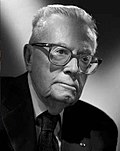 ,
A theory is only as good as its assumptions. If the premises are false, the theory has no real scientific value.
Too many theorists have a tendency to ignore facts that contradict their convictions.
Any author who uses mathematics should always express in ordinary language the meaning of the assumptions he admits, as well as the significance of the results obtained.
Awards
In their orbit
About this person
Born in Paris in 1911, Allais graduated from the École Polytechnique and initially leaned toward physics, studying pendular oscillations and gravitation. A 1933 trip to Depression-era America turned him toward economics. He spent his career at the École Nationale Supérieure des Mines de Paris, teaching there from 1944 and directing its Economic Analysis Centre from 1946. His refusal to write in English kept his pioneering work on market theory and resource allocation obscure to the dominant academic world; major contributions sat untranslated until others independently arrived at the same conclusions. He attended the first Mont Pelerin Society meeting but alone refused to sign its statement, breaking with the group over property rights. Samuelson later said that had Allais written in English from the start, "a generation of economic theory would have taken a different course." The Nobel came in 1988, decades after the work. He died in Saint-Cloud in 2010 at ninety-nine.
In common with Maurice
 Robert AumannBoth received Frederick W. Lanchester Prize
 Leonid KantorovichBoth received Prize in Economic Sciences in Memory of Alfred Nobel
 Guido ImbensBoth received Prize in Economic Sciences in Memory of Alfred Nobel
 Richard StoneBoth received Frederick W. Lanchester PrizeBernard ChenotBoth received Ordre de l'Économie nationale
 George AkerlofBoth received Prize in Economic Sciences in Memory of Alfred Nobel
Fame.am measures public visibility signals. It does not measure human value, talent, morality, or credibility.