
Martin Bormann
✓ Source-basedfallingGerman Nazi Party official and head of the Nazi Party Chancellery (1900-1945)
He never commanded an army or delivered a famous speech, but Martin Bormann wielded power by standing closest to Hitler - controlling who saw him, what information reached him, and which decisions left the room. That proximity made him one of the most dangerous men in the Third Reich.
Also inDeutsch
Photos 8
 Bundesarchiv Bild 183-R14128A, Martin Bormann
_Adolf_Hitler_Norw._new_Prime_Minister_Quisling_Reichskanzlei_Berlin_1942-02-13_Martin_Bormann_-_BAnQ_Biblioth..._Qu%C3%A9bec_PDM_cropped.jpg?width=1200) 06M P833S1D1358 0010 1 VIDKUN QUISLING (Norwegian Fascist politician WW2 Nazi collaborator 1887-1945) Adolf Hitler Norw. new Prime Minister Quisling Reichskanzlei Berlin 1942-02-13 Martin Bormann - BAnQ Biblioth... Québec PDM cropped
06M P833S1D1358 0010 1 VIDKUN QUISLING (Norwegian Fascist politician WW2 Nazi collaborator 1887-1945) Adolf Hitler Norw. new Prime Minister Quisling Reichskanzlei Berlin 1942-02-13 Martin Bormann - BAnQ Biblioth... Québec PDM cropped_Adolf_Hitler_Norw._new_Prime_Minister_Quisling_Reichskanzlei_Berlin_1942-02-13_Martin_Bormann_-_BAnQ_Biblioth..._Qu%C3%A9bec_PDM.jpg?width=1200) 06M P833S1D1358 0010 1 VIDKUN QUISLING (Norwegian Fascist politician WW2 Nazi collaborator 1887-1945) Adolf Hitler Norw. new Prime Minister Quisling Reichskanzlei Berlin 1942-02-13 Martin Bormann - BAnQ Biblioth... Québec PDM
06M P833S1D1358 0010 1 VIDKUN QUISLING (Norwegian Fascist politician WW2 Nazi collaborator 1887-1945) Adolf Hitler Norw. new Prime Minister Quisling Reichskanzlei Berlin 1942-02-13 Martin Bormann - BAnQ Biblioth... Québec PDM_Adolf_Hitler_Norw._new_Prime_Minister_Quisling_Reichskanzlei_Berlin_1942-02-13_(AP_photo_caption)_BAnQ_Biblioth%C3%A8que_et_Arch...PDM.jpg?width=1200) 06M P833S1D1358 0010 2 VIDKUN QUISLING (Norwegian Fascist politician WW2 Nazi collaborator 1887-1945) Adolf Hitler Norw. new Prime Minister Quisling Reichskanzlei Berlin 1942-02-13 (AP photo caption) BAnQ Bibliothèque et Arch...PDM
06M P833S1D1358 0010 2 VIDKUN QUISLING (Norwegian Fascist politician WW2 Nazi collaborator 1887-1945) Adolf Hitler Norw. new Prime Minister Quisling Reichskanzlei Berlin 1942-02-13 (AP photo caption) BAnQ Bibliothèque et Arch...PDM Bundesarchiv Bild 183-H12168, Nürnberg, Reichsparteitag der NSDAP
 Bundesarchiv Bild 121-0047, Nürnberg, Reichsparteitag, Eröffnung
 Bundesarchiv Bild 121-0048, Nürnberg, Reichsparteitag, Eröffnung
 Bundesarchiv Bild 146-1968-100-21A, Martin Bormann
In their own words 4
Situation very serious... Those ordered to rescue the Führer are keeping silent... Disloyalty seems to gain the upper hand everywhere... Reichskanzlei a heap of rubble.
Wired message to General Admiral Karl Dönitz, April 28, 1945.
The Slavs are to work for us. Insofar as we do not need them, they may die. Therefore, compulsory vaccination and German health service are superfluous.
Quoted in "The Trial of the Germans: An Account of the Twenty-Two Defendants Before the International Military Tribunal" - Page 101 by
National Socialism and Christianity are irreconcilable.
Quoted in "The Third Reich Sourcebook" - Page 440 - by Sander L. Gilman and Anson Rabinbach - History - 2013.
Awards 6
In their orbit 3

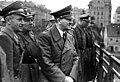
Connected to Martin 6


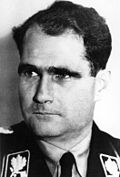

About this person
Born in Wegeleben in 1900, Bormann joined a Freikorps in 1922 and served nearly a year in prison as an accomplice in the murder of a school teacher. He joined the Nazi Party in 1927, worked in its insurance service, then transferred in 1933 to the office of Deputy Führer Rudolf Hess as chief of staff. After Hess's solo flight to Britain in May 1941, Bormann assumed his duties as Head of the Party Chancellery, gaining final approval over civil service appointments and helping review legislation. Appointed Hitler's personal secretary on 12 April 1943, he became a leading proponent of reducing church influence and favoured harsh treatment of Jews and Slavs in conquered territories. He returned with Hitler to the Führerbunker in January 1945 and attempted to flee Berlin on 2 May after Hitler's suicide. Bormann likely committed suicide near Lehrter station that same day; his body, buried on 8 May, remained unfound until 1972 and was confirmed by DNA in 1998. Tried in absentia at Nuremberg, he was convicted of war crimes and crimes against humanity.
 Germany
Fame.am measures public visibility signals. It does not measure human value, talent, morality, or credibility.