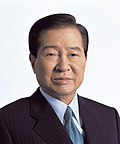
Kim Dae-jung
8th President of the Republic of Korea (1924-2009) · South Korea · Politicians · Died at 85
Kim Dae-jung is read about 1,222 times a day, in 83 languages.
A typical day, 30 days to 21 October 2026
The middle day of the days counted, so one week of news cannot move it. The line under it is the last 396 days, one point a day.
Something wrong?Five near-death experiences, six years in prison, a death sentence from his own government - and then he won the presidency at 74. Kim Dae-jung spent decades as the opposition figure South Korea's military dictators couldn't quite kill, and took the Nobel for opening a door to the North.
A life in dates
Also in Deutsch
Photos 8


In their own words 10
 ,
Eventually, North Korea will come out for dialogue.
So when the U.N. made a resolution and asked us to send troops to East Timor, we took this as a responsibility that we must take, and also this was to repay them for their favors.
For human rights issues, I think the intervention or support from the outside world is important.
Awards
Family
Kim Dae-jungPartners

Children
Is this everyone?
Only relatives with a profile here are drawn, so a family can be larger than this. A line here can also be wrong.
Correct this familyAbout this person
Kim Dae-jung left business for politics after the Korean War and joined the Democratic Party's reform wing. Through the 1960s to the 1980s he led the democratization movement against successive military regimes, surviving assassination attempts, a rigged car accident, imprisonment, house arrest, exile, and a death sentence. He lost presidential bids in 1971, 1987, and 1992 before finally winning in 1997 through an opposition alliance - the first time a non-ruling party candidate took the Blue House. He inherited the wreckage of the 1997 Asian financial crisis and steered South Korea through privatization and industrial restructuring. In June 2000 he held the first inter-Korean summit with Kim Jong Il under his Sunshine Policy of détente, earning the Nobel Peace Prize that December for his work on democracy, human rights, and reconciliation across East Asia. He left office in 2003 and died in August 2009 at 85 from pneumonia complications.
Politicians from South Korea 6




Fame.am measures public visibility signals. It does not measure human value, talent, morality, or credibility.