Jules Verne is read about 5,380 times a day, in 129 languages.
A typical day, 30 days to 15 October 2026
The middle day of the days counted, so one week of news cannot move it. The line under it is the last 390 days, one point a day.
Something wrong?He imagined submarines and moon rockets decades before they existed, then watched the world spend a century catching up. His novels mapped impossible journeys with such precision that engineers used them as blueprints.
A life in dates
Also in Deutsch
Photos 8
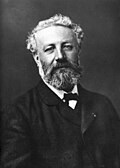
 Félix Nadar 1820-1910 portraits Jules Verne
 (Recueil.) Célébrités du XIXe siècle. III - btv1b10525048m (021 of 110)
 A Maravilhosa Vida de Santos=Dumont (page 18b crop)
 Amiens, Cedrus libani, Bd de Belfort
 Andrée Jules-Verne
 Bulletin de la Société Jules Verne
 Carte Flip Island (L'Oncle Robinson)
 Expo Julio Verne en Fuerte2
In their own words 2
 ,
Yes, but water decomposed into its primitive elements...
Hunger, prolonged, is temporary madness! The brain is at work without its required food, and the most fantastic notions fill the mind.
Listen
SpotifyOn YouTube
406 subscribersAwards
Family
Parents
 Jules Verne
Partners


Is this everyone?
Only relatives with a profile here are drawn, so a family can be larger than this. A line here can also be wrong.
Correct this familyAbout this person
Born in 1828, Jules Gabriel Verne became a French novelist whose partnership with publisher Pierre-Jules Hetzel launched the Voyages extraordinaires - a procession of bestselling adventure novels grounded in the scientific knowledge and technology of the second half of the 19th century. Journey to the Center of the Earth arrived in 1864, Twenty Thousand Leagues Under the Seas in 1870, Around the World in Eighty Days in 1872. Beyond novels he wrote plays, poetry, and scientific studies; his work fed cinema from its birth and has been adapted into nearly every medium since. France and Europe claimed him as a literary force who shaped the avant-garde and surrealism, while the Anglosphere long dismissed him as a children's writer, partly because translations butchered and abridged his books. Since the 1980s that reputation has corrected itself. He ranks as the second most-translated author in the world since 1979, trailing only Agatha Christie, ahead of Shakespeare, and holds the title of most-translated French author in the 2010s.






Fame.am measures public visibility signals. It does not measure human value, talent, morality, or credibility.