Joseph-Louis Lagrange is read about 752 times a day, in 91 languages.
A typical day, 30 days to 15 October 2026
The middle day of the days counted, so one week of news cannot move it. The line under it is the last 390 days, one point a day.
Something wrong?He reformulated all of classical mechanics without a single diagram - pure equations that could predict the motion of anything from pendulums to planets. Lagrange's methods became the hidden architecture beneath modern physics.
Also in Deutsch
Photos 8
 Лагранж
 11 Joseph Louis Lagrange
.JPG?width=1200) AduC 179 Lagrange (J.L., 1736-1813)
AduC 179 Lagrange (J.L., 1736-1813) BC AULB 130PP CS 100
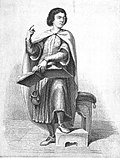
 BOYER 1276 - Joseph Louis Lagrange, Author of the Mécanique Analytique &c.
.jpg?width=1200) Buste Joseph-Louis Lagrange (1736-1813)
Buste Joseph-Louis Lagrange (1736-1813) Formule lagrange
_Medal%2C_1818_(CH_18154381).jpg?width=1200) Galerie métallique des grands hommes français (Great Men of France) Medal, 1818 (CH 18154381)
Galerie métallique des grands hommes français (Great Men of France) Medal, 1818 (CH 18154381)Awards
In their orbit 2
About this person
Born Giuseppe Luigi Lagrangia in Turin in 1736, he was already deep into mathematical analysis as a young man when Euler and d'Alembert noticed his work. In 1766 he succeeded Euler himself as director of mathematics at the Prussian Academy in Berlin, where he spent over twenty years writing volumes that won French Academy prizes. His *Mécanique analytique*, written in Berlin and published in 1788, gave classical mechanics its most comprehensive treatment since Newton and laid the groundwork for nineteenth-century mathematical physics. At 51 he left for Paris, became a member of the French Academy of Sciences, helped drive Revolutionary France's shift to the decimal system, and was named the first professor of analysis when the École Polytechnique opened in 1794. He became a Senator in 1799 and remained in France until his death in 1813.



Fame.am measures public visibility signals. It does not measure human value, talent, morality, or credibility.