Joseph de Maistre
Savoyard philosopher, writer, lawyer, and diplomat (1753-1821) · France · Academics · Died at 67
Joseph de Maistre is read about 604 times a day, in 47 languages.
A typical day, 30 days to 23 October 2026
The middle day of the days counted, so one week of news cannot move it. The line under it is the last 398 days, one point a day.
Something wrong?The intellectual who looked at the wreckage of the French Revolution and concluded that reason itself was the problem. Maistre spent decades arguing that only throne and altar could hold civilization together - a position that made him conservatism's sharpest, bleakest founding voice.
A life in dates
Also in Deutsch
Photos 7

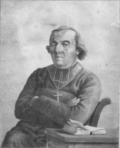
 Stipple engraving of Maistre from a painting by Pierre Bouillon in which he is shown wearing the insignia of the Order of Saints Maurice and Lazarus
 Portrait of Maistre by Swiss painter Félix Vallotton from La Revue blanche, 1895
 Statue of the Joseph and Xavier de Maistre brothers outside the old fortress in their hometown Chambéry
 Street named after Joseph de Maistre in Montmartre, Paris
 Joseph de Maistre's tomb at the Church of the Holy Martyrs in Turin
In their own words 10
 ,
, To know the nature of man, the most direct and wisest way undoubtedly is to know what he has always been. Since when can theories be opposed to facts?
Nations are barbarian in their infancy but not savage. The barbarian is a proportional mean between the savage and the citizen.
Man is an enigma whose knot has not ceased to occupy observers. The contradictions that he contains astonish reason and impose silence on it.
Family
Parents
 Joseph de Maistre
Partners
Children

Brothers and sisters

Is this everyone?
Only relatives with a profile here are drawn, so a family can be larger than this. A line here can also be wrong.
Correct this familyAbout this person
Born in 1753 in the Kingdom of Sardinia, Maistre was a lawyer by training and a subject of the King of Piedmont-Sardinia, French in language but not allegiance. He served in the Savoy Senate from 1787 to 1792, then watched the Revolution tear through the assumptions of the age. What followed was a career split between diplomacy - fourteen years as ambassador to the Russian Empire, then minister of state in Turin until his death - and a sustained ideological counteroffensive. Maistre held that monarchy was divinely sanctioned and the only stable form of government, that rationalism had directly caused the Terror, and that restoration of the Bourbons and Papal supremacy were Europe's only route back from chaos. He became a pillar of the Counter-Enlightenment and a forerunner of Romanticism, the man who gave conservatism its first coherent rejection of the Enlightenment project. He died in 1821, having spent his life insisting that order required submission.



Fame.am measures public visibility signals. It does not measure human value, talent, morality, or credibility.