John William Strutt, 3rd Baron Rayleigh
English physicist (1842-1919) · United Kingdom · Scientists · Died at 76
John William Strutt, 3rd Baron Rayleigh is read about 207 times a day, in 90 languages.
A typical day, 30 days to 15 October 2026
The middle day of the days counted, so one week of news cannot move it. The line under it is the last 390 days, one point a day.
Something wrong?He explained why the sky is blue, discovered a new element in the air, and left his name scattered across physics - from the scattering of light to the instability of fluids to the resolution limit of lenses.
A life in dates
Also in Deutsch
Photos 8
 John William Strutt
 Some Fellows of the Royal Society Wellcome V0006745
 Baron Rayleigh, PB00682
 Cavendish Laboratory - Free School Lane Cambridge CB2 3QA
 Cavendish Laboratory 1874-1974
 Evelyn Strutt (1846-1934)
 John William Strutt part
 John William Strutt, 3rd Baron Rayleigh. Colour lithograph b Wellcome V0004949
Awards
Family
Parents
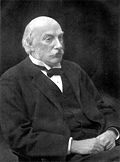 John William Strutt, 3rd Baron Rayleigh
Partners

Children

Is this everyone?
Only relatives with a profile here are drawn, so a family can be larger than this. A line here can also be wrong.
Correct this familyAbout this person
John William Strutt, 3rd Baron Rayleigh, was a British physicist born 12 November 1842 into a hereditary peerage. In 1871 he published the first theoretical treatment of elastic light scattering by particles much smaller than the wavelength - Rayleigh scattering - which explained the blue of the sky. He described transverse surface waves in solids (Rayleigh waves), contributed circulation theory for aerodynamic lift, and introduced the Rayleigh number, Rayleigh flow, the Rayleigh-Taylor instability, and the stability criterion for Taylor-Couette flow. In optics he proposed a criterion for angular resolution; in thermodynamics his Rayleigh-Jeans law for black-body radiation later helped birth quantum mechanics. His 1877 textbook The Theory of Sound remains in use. In 1904 he won the Nobel Prize in Physics for discovering argon. He served as President of the Royal Society from 1905 to 1908 and as Chancellor of the University of Cambridge from 1908 until his death on 30 June 1919.
In common with John
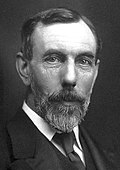 William RamsayBoth received Barnard Medal for Meritorious Service to Science
 Hermann von HelmholtzBoth received Faraday Lectureship Prize
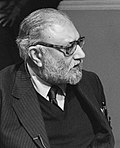 Abdus SalamBoth received Matteucci Medal
 G.H. HardyBoth received De Morgan Medal
 Arnold SommerfeldBoth received Matteucci Medal
 Peter DebyeBoth received Faraday Lectureship Prize
Fame.am measures public visibility signals. It does not measure human value, talent, morality, or credibility.