John Kendrew
English biochemist and crystallographer (1917-1997) · United Kingdom · On the map · Scientists · Died at 80
Kendrew cracked the three-dimensional structure of a protein - myoglobin - and made the invisible architecture of life visible for the first time.
John Kendrew is read about 39 times a day, in 62 languages.
A typical day, 30 days to 17 September 2026
The middle day of the days counted, so one week of news cannot move it. The line under it is the last 60 days, one point a day.
Something wrong?A life in dates
People around John
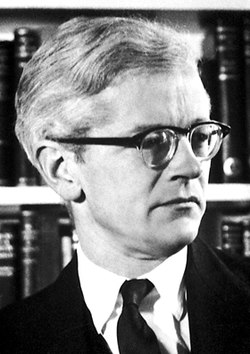


 John Kendrew
Is this everyone?
Only relatives with a profile here are drawn, so a family can be larger than this. A line here can also be wrong.
Correct this familyAlso in Deutsch
Media & music


Awards
About this person
John Cowdery Kendrew was born on 24 March 1917 in England, trained as a biochemist, and landed at the Cavendish Laboratory, where the hardest problems in science tended to gather. Working alongside Max Perutz, he used X-ray crystallography to map the atomic coordinates of haem-containing proteins - a task most thought impossible. The work paid off: in 1962, he and Perutz shared the Nobel Prize in Chemistry for revealing how proteins actually fold and function in three dimensions. Kendrew later moved into science administration, but the myoglobin structure remained his mark - the first time anyone had seen a protein's shape with their own eyes. He died on 23 August 1997.


