John Everett Millais
British painter and illustrator (1829-1896) · United Kingdom · Artists · Died at 67
John Everett Millais is read about 772 times a day, in 53 languages.
A typical day, 30 days to 15 September 2026
The middle day of the days counted, so one week of news cannot move it. The line under it is the last 60 days, one point a day.
Something wrong?He painted one of Victorian England's most scandalous pictures at twenty, co-founded a movement that tried to undo centuries of art tradition, then spent the second half of his career getting rich - which his old allies read as betrayal.
Also in Deutsch
Photos 8
 Millais - Self-Portrait
 17 of 'A Dream of a Garden and other poems ... With floral illustrations by W. F. M' (11304932066)
 A Momentary Vision that Once Befell Young Millais
 Affiche de la première exposition internationale d'art de la ville de Venise en 1895 (15612917050)

 Fotoreproductie van A Huguenot, on St. Bartholomew's Day, Refusing to Shield Himself from Danger by Wearing the Roman C, RP-F-2005-105-30
 Fotoreproductie van Een Hugenoot door John Everett Millais, RP-F-2003-27
 Fotoreproductie van een schilderij van John Everett Millais The Huguenot. Millais. (titel op object), RP-F-F01018-BC
Awards
Family
Parents
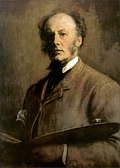 John Everett Millais
Partners

Children


Is this everyone?
Only relatives with a profile here are drawn, so a family can be larger than this. A line here can also be wrong.
Correct this familyAbout this person
Millais entered the Royal Academy Schools at eleven, the youngest student in its history. In 1848, the Pre-Raphaelite Brotherhood was founded at his family home on Gower Street, and he became its star: Christ in the House of His Parents stirred fierce controversy in 1849-50, and Ophelia in 1851-52 became the movement's defining image. By the mid-1850s he had begun drifting from Pre-Raphaelite rigor toward a looser realism that made him wealthy and famous - and led former admirers like William Morris to accuse him of selling out, especially after he lent a painting to a soap advertisement. His personal life tangled with his reputation: he married Effie, formerly the wife of critic John Ruskin, whose marriage had been annulled; she became a shrewd promoter of his work. Early twentieth-century critics dismissed his later paintings, but recent decades have repositioned them as part of broader shifts in late Victorian art.
Artists from the United Kingdom 6


Fame.am measures public visibility signals. It does not measure human value, talent, morality, or credibility.