
John B. Goodenough
✓ Source-basedstableAmerican materials scientist (1922-2023)
John Bannister Goodenough was an American materials scientist, a solid-state physicist, and a Nobel laureate in chemistry. From 1986 he was a professor of Materials Science, Electrical Engineering and Mechanical Engineering, at the University of Texas at Austin.
Text from Wikipedia, CC BY-SA 4.0
Also inDeutsch
Photos 3


Awards 20
In their orbit 1
Connected to John 6

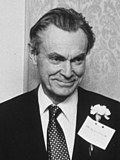


About this person
John Bannister Goodenough was an American materials scientist, a solid-state physicist, and a Nobel laureate in chemistry. From 1986 he was a professor of Materials Science, Electrical Engineering and Mechanical Engineering, at the University of Texas at Austin. He is credited with identifying the Goodenough-Kanamori rules of the sign of the magnetic superexchange in materials, with developing materials for computer random-access magnetic memory and with inventing cathode materials for lithium-ion batteries.
Text from Wikipedia, CC BY-SA 4.0
 United States
Fame.am measures public visibility signals. It does not measure human value, talent, morality, or credibility.