Johann Gottlieb Fichte is read about 705 times a day, in 84 languages.
A typical day, 30 days to 15 October 2026
The middle day of the days counted, so one week of news cannot move it. The line under it is the last 390 days, one point a day.
Something wrong?He built the scaffolding for German idealism and cracked open the problem of self-consciousness in ways Kant hadn't - then got credit stolen for dialectics he actually invented.
A life in dates
Also in Deutsch
Photos 8
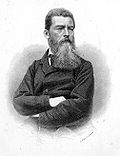
 Johann Gottlieb Fichte by Friedrich Bury
 20100731030DR Dresden-Plauen Johann Gottlieb Fichte Medaillon
 2018.05.15.Fichteturm Dresden 012
 Americana Fichte Johann Gottlieb
 Arthur Kampf 1915 Fichte als Redner Berlin Universität
 Bundesarchiv Bild 102-14231, Berlin, Reichsgründungsfeier der Universität
 Das Romantikerhaus in Jena 01
 DDR 1962 Michel 890
In their own words 10
 ,
, I posit myself as rational, that is, as free. In doing so I have the representation of freedom. In the same undivided act I posit other free beings.
The conception of Rights involves that when men are to live in a community, each must so restrict his freedom as to permit the coexistence of the freedom of all others.
The subject must distinguish itself through opposition from the rational being, which it has assumed outside of itself.
Family
Parents
Johann Gottlieb FichtePartners

Is this everyone?
Only relatives with a profile here are drawn, so a family can be larger than this. A line here can also be wrong.
Correct this familyAbout this person
Johann Gottlieb Fichte was born on 19 May 1762 in Germany and spent his career wrestling with the same puzzle that had occupied Descartes and Kant: how does a subject become aware of itself? His answer - original insights into the structure of self-awareness - made him a founding figure of German idealism, the philosophical movement that grew from Kant's theoretical and ethical work. He originated the thesis-antithesis-synthesis framework, though Hegel would later get the credit. Beyond pure philosophy, Fichte turned to political theory, writing works that earned him a reputation as one of the fathers of German nationalism. He died on 29 January 1814.


Fame.am measures public visibility signals. It does not measure human value, talent, morality, or credibility.