Jean-Auguste-Dominique Ingres is read about 715 times a day, in 122 languages.
A typical day, 30 days to 28 October 2026
The middle day of the days counted, so one week of news cannot move it. The line under it is the last 400 days, one point a day.
Something wrong?The French painter who spent decades defending Neoclassical orthodoxy against the Romantics, only to warp form and space in ways that fed directly into Matisse and Picasso. He thought of himself as a history painter in the David mold; the world remembers the portraits.
A life in dates
Also in Deutsch
Photos 8
 Ingres, Self-portrait
 Bruxelles. Musée d'Art Moderne. Jean-Dominique Ingres (1780-1867). Auguste écoutant la lecture de l'Eneïde - Brussel. Museum voor Moderne Kunst. Jean-Dominique Ingres (1780-1867)., GP018384 (2)
 Etude pour le Jules César
 François Ier reçoit les derniers soupirs de Léonard de Vinci, PDUT1165(1)
 François Ier reçoit les derniers soupirs de Léonard de Vinci, PDUT1165(2)
 Hats ingres
 Histoire des Arts à travers les Âges. (Partie de droite - repères 48 à 61 - France, XIXe siècle - détail - Jean-Dominique Ingres) - dessin - dessin sur papier - Joseph Blanc - btv1b53095049d
 Histoire des Arts à travers les Âges. (Partie de droite - repères 48 à 61 - France, XIXe siècle) - dessin - dessin sur papier - Joseph Blanc - btv1b53095048z
Awards
Family

 Jean-Auguste-Dominique Ingres
Partners
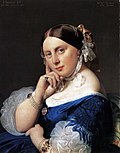
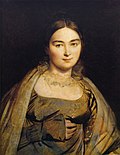
Is this everyone?
Only relatives with a profile here are drawn, so a family can be larger than this. A line here can also be wrong.
Correct this familyAbout this person
Born in Montauban in 1780, Ingres studied under David in Paris and won the Prix de Rome in 1802 for The Ambassadors of Agamemnon in the tent of Achilles. His style - shaped by close study of Italian and Flemish Renaissance masters - was set by the time he left for Rome in 1806, and it barely shifted after. For eighteen years in Rome and Florence, he sent canvases back to the Paris Salon that critics called bizarre and archaic; commissions for the grand history paintings he wanted dried up, so he survived on portraits and drawings. Recognition finally came in 1824 when The Vow of Louis XIII won over the Salon, crowning him the leader of French Neoclassicism. A decade later, stung by attacks on The Martyrdom of Saint Symphorian, he returned to Italy to direct the French Academy in Rome, then settled in Paris for good in 1841. He closed his career painting women's portraits, stained-glass designs, and at eighty-three finished The Turkish Bath, the last of his Orientalist nudes.



Fame.am measures public visibility signals. It does not measure human value, talent, morality, or credibility.