Isoroku Yamamoto
Japanese Marshal Admiral (1884-1943) · Japan · Historical Figures · Died at 59
Isoroku Yamamoto is read about 3,103 times a day, in 65 languages.
A typical day, 30 days to 15 October 2026
The middle day of the days counted, so one week of news cannot move it. The line under it is the last 390 days, one point a day.
Something wrong?He planned Pearl Harbor knowing Japan would likely lose the war. The admiral who led the Combined Fleet through the Pacific's opening blows understood American industrial power better than most in Tokyo - he'd studied at Harvard and walked Washington as a naval attaché - but was tasked with striking first anyway.
Also in Deutsch
Photos 8
 Yamamoto-Isoroku
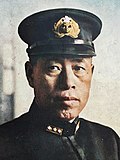
 Admiral Isoroku Yamamoto
 Admiral Yamamoto and Robert Craigie
 Admiral Yamamoto in Rabaul 1943
 Admiral Yamamoto on Guadalcanal Saluting a Japanese Plane
 Capt. Isoroku Yamamoto, Sec. Wilbur, Capt. Kiyoshi Hasegawa & Admiral Eberle, (2-17-26) LCCN2016850839
 Combined Fleet Staff in Yamato
 Commander-in-Chief of the Combined Fleet Isoroku Yamamoto on the bridge of the battleship Nagato (1)
In their own words 4
 ,
A military man can scarcely pride himself on having "smitten a sleeping enemy"; it is more a matter of shame, simply, for the one smitten.
Should hostilities once break out between Japan and the United States, it is not enough that we take Guam and the Philippines, nor even Hawaii and San Francisco.
In the first six to twelve months of a war with the United States and Great Britain I will run wild and win victory upon victory.
Awards
In their orbit
About this person
Yamamoto graduated from the Imperial Naval Academy in 1904 and lost two fingers at the Battle of Tsushima during the Russo-Japanese War. His time at Harvard and as naval attaché in Washington taught him that Japan's access to oil and industrial capacity couldn't match America's, leaving little hope in prolonged conflict. By 1936 he was navy vice minister, opposing the Tripartite Pact with Germany and Italy, yet in 1939 he took command of the Combined Fleet and designed the December 1941 surprise strike that opened the Pacific War. Early Japanese victories gave way to catastrophic loss at Midway in June 1942, where four carriers went down. He committed forces to Guadalcanal but couldn't hold the Solomons. In April 1943, American code breakers read his flight plans and sent fighters to intercept his plane over New Guinea.
Historical Figures from Japan 6



Fame.am measures public visibility signals. It does not measure human value, talent, morality, or credibility.