Igor Stravinsky
Russian, French, and American composer (1882-1971) · France · Musicians · Died at 88 · also Russia · also United States · also Switzerland
Igor Stravinsky is read about 2,028 times a day, in 143 languages.
A typical day, 30 days to 17 October 2026
The middle day of the days counted, so one week of news cannot move it. The line under it is the last 392 days, one point a day.
Something wrong?The Rite of Spring nearly started a riot at its 1913 premiere, and Stravinsky spent the next half-century proving that shock wasn't luck. He rewrote the rules of rhythm, then abandoned his own style twice more - Russian folklore, then neoclassical forms, then twelve-tone serialism - leaving each genre transformed.
A life in dates
Also in Deutsch
Photos 8
 Igor Stravinsky LOC 32392u
 Anton Hartman meets Igor Stravinsky at airport
 Anunci concert
 Columbus Symphony Orchestra concert in the Ohio Theater
 Complexe sonore
 Donaueschingen- Donaueschinger Musiktage; Igor Strawinsky gibt Autogramm an Max Rieple - LABW - Staatsarchiv Freiburg W 134 Nr. 054187a
 Donaueschingen- Donaueschinger Musiktage; Igor Strawinsky gibt Autogramm an Max Rieple - LABW - Staatsarchiv Freiburg W 134 Nr. 054187b
 Donaueschingen- Donaueschinger Musiktage; Igor Strawinsky gibt Autogramme - LABW - Staatsarchiv Freiburg W 134 Nr. 054186a
In their own words 9
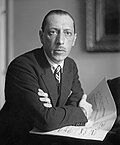 ,
, One has a nose. The nose scents and it chooses. An artist is simply a kind of pig snouting truffles.
My music is best understood by children and animals.
As for myself, I need music for hygienic purposes, for the health of my soul. Without music in its best sense there is chaos.
Listen
SpotifyAlbums 24
 IDIgor Stravinsky: The Fairy's Kiss; Peter I. Tchaikovsky: Bluebird Pas De Deux
 TTThe Soldier's Tale
 SGStravinsky: Symphony of Psalms / Poulenc: Gloria
Awards
Family
 Igor Stravinsky
Partners


Children

Is this everyone?
Only relatives with a profile here are drawn, so a family can be larger than this. A line here can also be wrong.
Correct this familyAbout this person
Born into a musical family in Saint Petersburg in 1882, Stravinsky studied law before Nikolai Rimsky-Korsakov took him on as a pupil. Impresario Sergei Diaghilev commissioned three ballets for Paris - The Firebird, Petrushka, and the scandalous Rite of Spring - that made him a name by 1913. He moved through three distinct periods: Russian folk-inflected works like Les noces, a neoclassical stretch drawing on Greek myth and sonata form (Apollon musagète, Oedipus rex), and finally a serial phase adopting twelve-tone technique in pieces like In Memoriam Dylan Thomas. The constant reinvention baffled supporters but redefined what rhythm and form could do in modern music, influencing composers from Copland to Boulez. He died of pulmonary edema in New York in 1971, leaving six memoirs and a Requiem Canticles performed at his funeral.
In common with Igor


Fame.am measures public visibility signals. It does not measure human value, talent, morality, or credibility.