Ibn Arabi is read about 1,277 times a day, in 73 languages.
A typical day, 30 days to 15 October 2026
The middle day of the days counted, so one week of news cannot move it. The line under it is the last 390 days, one point a day.
Something wrong?A thirteenth-century Andalusian mystic whose cosmology reshaped Islamic thought for centuries. His doctrine of wahdat al-wujūd - the unity of existence, where all things are manifestations of a single Absolute - made him either a saint or a heretic depending on who was reading.
Also in Deutsch
Photos 8

.jpg?width=1200)


In their own words 3
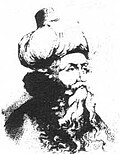 ,
, Every self-manifestation bestows a new creation and removes a pre-ceding creation.
I take love as my religion wherever its caravans lead, for love is my religion and my faith.
His is the wisdom of singularity because he is the most perfect existent in the human species. That is why the whole affair began with him and is sealed with him.
About this person
Ibn 'Arabī was born in al-Andalus in July 1165, a Sunni Muslim Arab who moved through scholarship, poetry, and Sufi practice until he arrived at something harder to categorize. He was the first to explicitly map out wahdat al-wujūd, a monist metaphysics claiming the universe as expressions of one reality he called the Absolute. The framework spread. His cosmological teachings became dominant across much of the Muslim world, and of the 850 works attributed to him, 700 are considered authentic - 400 still survive. He died in November 1240. Sufis began calling him Shaykh al-Akbar, the Greatest Shaykh, and the title stuck long after the man was gone.



Fame.am measures public visibility signals. It does not measure human value, talent, morality, or credibility.