Hermann Ebbinghaus is read about 246 times a day, in 45 languages.
A typical day, 30 days to 8 October 2026
The middle day of the days counted, so one week of news cannot move it. The line under it is the last 83 days, one point a day.
Something wrong?He turned memory from philosophical musing into hard data - inventing the forgetting curve and proving that what we retain drops fast, then levels off, unless we space the repetition just right.
A life in dates
Also in Deutsch
Photos 8


In their own words 10
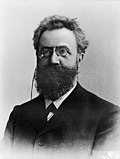 ,
A poem is learned by heart and then not again repeated.
The constant flux and caprice of mental events do not admit of the establishment of stable experimental conditions.
The relation of repetitions for learning and for repeating English stanzas needs no amplification.
About this person
Hermann Ebbinghaus was born on 24 January 1850 in Germany, at a time when memory was considered too subjective to measure. He built the experimental study of memory from scratch, using himself as subject and nonsense syllables as material to strip out meaning's interference. In the process he discovered the forgetting curve - the steep drop-off of retention over time - and the spacing effect, which showed that distributed practice beats cramming. He also became the first to describe the learning curve. His work gave psychology one of its earliest quantitative foundations. He died on 26 February 1909, leaving behind not only those curves but a son, Julius Ebbinghaus, who became a neo-Kantian philosopher.



Fame.am measures public visibility signals. It does not measure human value, talent, morality, or credibility.