Herbert Kroemer
German-American physics (1928-2024) · Germany · Scientists · Died at 95
Herbert Kroemer is read about 51 times a day, in 61 languages.
A typical day, 30 days to 17 September 2026
The middle day of the days counted, so one week of news cannot move it. The line under it is the last 60 days, one point a day.
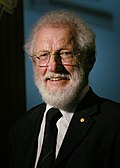
Something wrong?Herbert Kroemer engineered the semiconductor structures that made modern optoelectronics possible - the physics that lets your phone exist. He shared the 2000 Nobel Prize in Physics for work that turned out to be a foundational step toward mobile communications.
A life in dates
Also in Deutsch
Photos 3
.jpg?width=1200)
.jpg?width=1200)

In their own words 4
 ,
, Whenever I came to him (Fritz Sauter) with a pure physics idea, he would invariably say, with slight sarcasm: "But Mr.
The principal applications of any sufficiently new and innovative technology always have been - and will continue to be - applications created by that technology.
Ultimately, progress in applications is not deterministic, but opportunistic, exploiting for new applications whatever new science and technology happen to be coming along.
Awards
About this person
Born in Germany on August 25, 1928, Kroemer built his career at the seam between materials and electronics. His research into transistors, particularly semiconductor heterostructures developed alongside Zhores Alferov, cracked open new possibilities in high-speed and optical electronics. The Nobel committee recognized the pair in 2000 for innovations that would later anchor mobile phone technology. Kroemer spent his final decades as a professor of electrical engineering at the University of California, Santa Barbara. He died on March 8, 2024.
In common with Herbert




Fame.am measures public visibility signals. It does not measure human value, talent, morality, or credibility.