Herbert A. Simon
American political scientist, economist, sociologist, and psychologist (1916-2001) · United States · Academics · Died at 84
Herbert A. Simon is read about 579 times a day, in 63 languages.
A typical day, 30 days to 15 October 2026
The middle day of the days counted, so one week of news cannot move it. The line under it is the last 390 days, one point a day.
Something wrong?He cracked the code on how humans actually decide - not as perfect calculators, but as creatures settling for "good enough" under pressure. That insight, "bounded rationality," won him a Nobel and reshaped economics, AI, and management in one stroke.
A life in dates
Also in Deutsch
Photos 3


In their own words 10
 ,
, Economic man deals with the "real world" in all its complexity. Administrative man recognizes that the world he perceives is a drastic simplified model...
It is not my aim to surprise or shock you - but the simplest way I can summarize is to say that there are now in the world machines that think, that learn and that create.
Over Christmas, Allen Newell and I created a thinking machine.
Awards
About this person
Born June 15, 1916, Simon spent most of his career at Carnegie Mellon from 1949 until his death in 2001, helping establish one of the world's first computer science departments. His core obsession was decision-making inside organizations, which led him to reject the fantasy of rational actors and argue instead that people "satisfice" - seek workable solutions within limits. The theory earned him the Nobel Memorial Prize in Economic Sciences in 1978. Three years earlier, he and Allen Newell had shared the Turing Award for pioneering artificial intelligence and information processing. Along the way he analyzed the architecture of complexity and proposed mechanisms behind power law distributions, stitching together cognitive science, public administration, and complex systems into a single interdisciplinary lens. He died February 9, 2001.
In common with Herbert
 Geoffrey HintonBoth received IJCAI Award for Research Excellence
 Joseph StiglitzBoth received Prize in Economic Sciences in Memory of Alfred Nobel
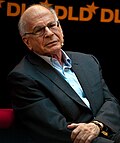 Daniel KahnemanBoth received Prize in Economic Sciences in Memory of Alfred Nobel
 John McCarthyBoth received IJCAI Award for Research Excellence
 James G. MarchBoth received John Gaus Award
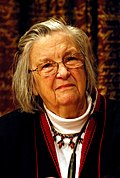 Elinor OstromBoth received Prize in Economic Sciences in Memory of Alfred Nobel
Fame.am measures public visibility signals. It does not measure human value, talent, morality, or credibility.