Heraclitus
Greek philosopher (late 6th/early 5th-century BC) · Turkey · Academics · Lived 535 BC to 470 BC · aged 65
Heraclitus is read about 2,238 times a day, in 97 languages.
A typical day, 30 days to 15 October 2026
The middle day of the days counted, so one week of news cannot move it. The line under it is the last 390 days, one point a day.
Something wrong?He wrote in riddles so knotted that ancient readers called him "the obscure" and "the dark." His one book survives only in fragments, but the core claim - everything flows, you can't step in the same river twice - runs underneath twenty-five centuries of Western thought.
Also in Deutsch
Photos 12

 Theater in Ephesus on the coast of Asia Minor, birthplace of Heraclitus
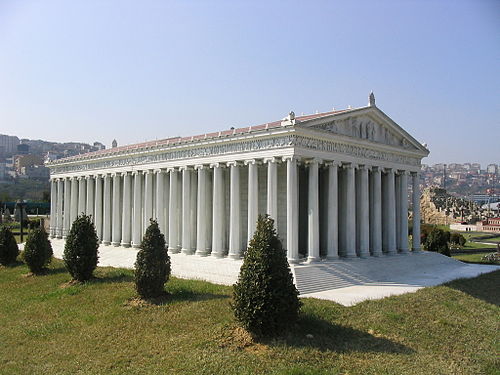 A modern miniature model of the Ephesian Temple of Artemis, located in modern Istanbul. According to Diogenes Laertius, Heraclitus deposited his book in the temple.
 Heraclitus's writing style has been compared to a sibyl, as depicted here by Domenichino.
 The Halys River, Turkey's longest. Heraclitus's theory of flux has been associated with the metaphor of a flowing river.
 Dike depicted on the Vermont state house. Heraclitus considered strife fundamental to a just world.
 Heraclitus believed the cosmos "no god nor man did create, but it ever was and is and will be: ever-living fire".
 Heraclitus (named outlined in red) in a fragment of Oxyrhynchus Papyri discusses the Moon.
In their own words 10
 ,
, The Cosmos is child's play: a child playing chess as King.
Using English idioms to parallel the original's wordplay.
History is a child building a sand-castle by the sea, and that child is the whole majesty of man’s power in the world.
About this person
Heraclitus lived around 500 BC in Ephesus, then under Persian rule, and wrote a single work now lost except for scattered pieces. Even in antiquity his paradoxes and cryptic epigrams made him hard to parse; his temperament didn't help - contemporaries thought him arrogant, depressed, misanthropic, earning him the nickname "the weeping philosopher" in contrast to Democritus the laughing one. His philosophy turned on the unity of opposites and the primacy of change: the world constantly in flux, always becoming, never static being, with harmony found in strife itself. He believed fire was the fundamental element and that logos - reason or divine law - gave structure to the ceaseless transformation. Plato, Aristotle, the Stoics, Hegel, Nietzsche, Heidegger: all carried forward arguments first sketched in his gnomic lines.
Academics from Turkey 6


Fame.am measures public visibility signals. It does not measure human value, talent, morality, or credibility.