Henri Matisse is read about 3,028 times a day, in 158 languages.
A typical day, 30 days to 18 October 2026
The middle day of the days counted, so one week of news cannot move it. The line under it is the last 393 days, one point a day.
Something wrong?Matisse made colour do things it hadn't done before - not just bright, but structurally load-bearing, the way other painters used line. That gamble, and the fifty years of invention that followed, put him next to Picasso as the hinge between centuries.
A life in dates
Also in Deutsch
Photos 8
 Portrait of Henri Matisse 1933 May 20
 Group picture of Matisse's students, 1909
 StraubeAcademieMatisse
 Collioure hôtel de la gare Matisse Derain 1
 Collioure hôtel de la gare Matisse Derain 2
 Henri Matisse Arbre généalogique 1
 Henri Matisse, Léonide Massine et Boris Kochno dans la salle de répétition de l'Opéra de Monte-Carlo - btv1b70022414
 Henri Matisse, Léonide Massine, et Boris Kochno dans salle de répétition de l'Opéra de Monte-Carlo - btv1b7002242j
In their own words 10
 ,
, Rules have no existence outside of individuals: otherwise a good professor would be as great a genius as Racine.
Expression for me does not reside in passions glowing in a human face or manifested by violent movement.
For me all is in the conception. I must therefore have a clear vision of the whole from the beginning.
Awards
Family
Henri MatissePartners

Children


Is this everyone?
Only relatives with a profile here are drawn, so a family can be larger than this. A line here can also be wrong.
Correct this familyAbout this person
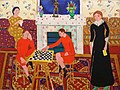
Born in 1869, Henri Émile Benoît Matisse trained as a draughtsman and sculptor but found his edge as a painter. Between 1900 and 1905 his work turned so aggressively chromatic that critics dubbed him and his circle the Fauves - wild beasts. He spent the next decade after 1906 tightening that wildness into something harder: flattened forms, decorative pattern, a rigorous new syntax. In 1917 he moved to Nice, and through the 1920s his work softened enough to win him praise as a guardian of French classical painting. After 1930 he simplified further, paring down to essentials. When illness stopped him from holding a brush, he turned to cut paper and produced a final body of collage work that proved he could still invent. He died in 1954, having spent more than half a century redrawing the expressive possibilities of colour and form.




Fame.am measures public visibility signals. It does not measure human value, talent, morality, or credibility.