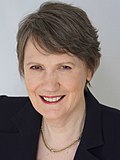
Helen Clark
✓ Source-basedstablePrime Minister of New Zealand from 1999 to 2008
 in New Zealand
New Zealand's second female prime minister held the job for nine years across three terms, then left Parliament to run the UN's development arm and nearly became secretary-general.
Also inDeutsch
Photos 12


 With Paul Wolfowitz at the Pentagon, 26 March 2002
 Clark with Indian Prime Minister Manmohan Singh, 20 October 2004
 Clark meets US President George W. Bush at the White House, 22 March 2007.
 Clark in the Asia-Pacific Economic Cooperation Summit in Sydney, 9 September 2007
 With her successor as Prime Minister, John Key, 22 September 2009
In their own words 6
We have a lot of issues to sort through, most of them because of the pandemic. 11 million girls have not returned to school since 2020 and that’s a problem we should solve.
Women Deliver delegates on the importance of open dialogue The New Times (July 18, 2023)
People weren’t used to the prospect of a woman becoming prime minister so there were attacks about my appearance, my voice and even my clothing.
Quoted in Gitika Bhardwaj, Helen Clark on why the world needs more women to tackle global crises (8 March 2022)
I believe I'm the best person for the job. Obviously I'm a woman, but I've never sought election on the basis of being a woman.
Quoted in "'I have the skills for the job' - Helen Clark on bid for top UN job" (5 April 2016)
Awards 11
Connected to Helen 6
 Ma Ying-jeouAlso won Star of the Solomon Islands
 Queen Elizabeth The Queen MotherAlso won Order of New Zealand
 Tim FinnAlso won honorary doctor of the University of Waikato
 Waylon JenningsAlso won Lifetime Achievement award
 Ngũgĩ wa Thiong'oAlso won honorary doctor of the University of Auckland
 Zhores AlferovAlso won Order of Francisc Skorina
About this person
Helen Clark grew up on a farm outside Hamilton, studied politics at the University of Auckland from 1968, and joined Labour while still a student. She lectured in political studies before entering Parliament in 1981 as the member for Mount Albert, a seat she kept until 2009. She held Cabinet posts in housing, health, and conservation through the Fourth Labour Government and served as deputy prime minister from 1989 to 1990. After Labour's narrow loss in 1993, she challenged Mike Moore for the leadership and won. She became prime minister on 10 December 1999 and led the Fifth Labour Government through three elections, launching Kiwibank, KiwiSaver, the Superannuation Fund, and an emissions trading scheme, while deploying troops to Afghanistan but not Iraq and signing New Zealand's first free-trade deal with China. Defeated in 2008, she resigned in November and left Parliament the following April to become the first woman to head the United Nations Development Programme, a role she held until 2017.
New ZealandFame.am measures public visibility signals. It does not measure human value, talent, morality, or credibility.