Heinrich Schütz is read about 177 times a day, in 49 languages.
Counted to 15 September 2026, not since.
The middle day of the days counted, so one week of news cannot move it. The line under it is the last 60 days, one point a day.
Something wrong?The hinge between Renaissance polyphony and German Baroque drama. Schütz pulled Italian theatrical intensity north, wrote the first German opera - then watched the score vanish - and spent half a century turning Lutheran liturgy into something vivid and strange.
Also in Deutsch
Photos 8

_Heinrich_Sch%C3%BCtz.jpg?width=1200)


_06.jpg?width=1200)
Listen
SpotifyAlbums 24
 SSSchütz: Cantiones Sacrae 1625
 MEMusicalische Exequien
 MOMotetsMVMusicalische Vesper
Family
Is this everyone?
Only relatives with a profile here are drawn, so a family can be larger than this. A line here can also be wrong.
Correct this familyAbout this person
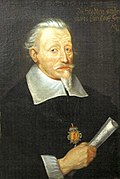
Born in 1585, Schütz crossed the Alps to absorb the Italian style, then brought it back to the Electoral Chapel in Dresden, where he wrote most of his music for Lutheran services. In 1627 he staged Dafne at Torgau, traditionally considered the first German opera; the music is lost, along with nearly all his ceremonial and theatrical work. What survived - more than 500 pieces - kept evolving through decades of war and upheaval, pushing sacred music from Renaissance forms into early Baroque drama. He died in 1672, a century before Bach, whose shadow would eventually swallow his name. Some North American Lutheran churches commemorate him on 28 July alongside Bach and Handel.


Fame.am measures public visibility signals. It does not measure human value, talent, morality, or credibility.