Harun al-Rashid
5th Abbasid caliph (r. 786-809) · Politicians · Lived 766 to 809 · aged 43
Harun al-Rashid is read about 1,545 times a day, in 85 languages.
A typical day, 30 days to 15 October 2026
The middle day of the days counted, so one week of news cannot move it. The line under it is the last 390 days, one point a day.
Something wrong?The Abbasid caliph whose court became shorthand for opulence and intrigue - less for what he actually did than for the fictional version that lodged in global imagination. He ruled Baghdad at its apex, then got immortalized in folktales that outlasted the empire.
Also in Deutsch
Photos 8
 Harun Al-Rashid and the World of the Thousand and One Nights
 Jacob Jordaens - Tribute of the Caliph Harun al-Rashid to Charlemagne
 Charlemagne Clock
 Wasseruhr Harun al Raschid
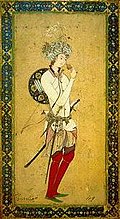
 Abbāsid Caliph Hārūn al-Rashīd from the genealogy (silsilanāma), Cream of Histories (Zübdet-üt Tevarih, 1598)
 Arab-figures
 Bihhzad 001
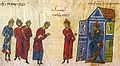
 Calife Abbasside Charlemagne
In their own words 2
 ,
I endured afflictions and sowrrow / When death took Haylanah to itself. / I parted from my happiness when I lost her / And care not now what it may be.
O, mistress of the mansion in Firk, / And mistress of the Sultan and his kingdom / For God's sake, spare to slay me / For I am neither Daylam nor Turk.
Family
Parents
 Harun al-Rashid
Partners
Children


Brothers and sisters

Is this everyone?
Only relatives with a profile here are drawn, so a family can be larger than this. A line here can also be wrong.
Correct this familyAbout this person
Harun al-Rashid became the fifth Abbasid caliph in September 786, inheriting an empire on the edge of its golden age. He founded the House of Wisdom in Baghdad, turning the city into a nexus of knowledge and trade, and his reign is marked as the beginning of the Islamic Golden Age. In 796 he moved his court to Raqqa in present-day Syria; the Abbasid Empire reached its peak under his rule, though the Barmakid family that had helped install the dynasty began its decline. He exchanged embassies with Charlemagne in 799, sending gifts that included a clock the Frankish court thought was sorcery. He died in March 809, but his afterlife proved longer: One Thousand and One Nights set portions of its tales in his court, and the line between the historical caliph and the literary figure blurred into legend.
Politicians born in the 760s 3


Fame.am measures public visibility signals. It does not measure human value, talent, morality, or credibility.