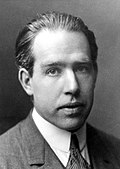
Hans Christian Ørsted
Danish physicist and chemist (1777-1851) · Denmark · On the map · Scientists · Died at 73
He noticed that a compass needle twitched near a live wire - the first proof that electricity and magnetism weren't separate forces but two faces of the same thing.
Hans Christian Ørsted is read about 305 times a day, in 91 languages.
A typical day, 30 days to 1 November 2026
The middle day of the days counted, so one week of news cannot move it. The line under it is the last 400 days, one point a day.
Something wrong?A life in dates
People around Hans



 Hans Christian Ørsted
Partners
Children
Brothers and sisters

Is this everyone?
Only relatives with a profile here are drawn, so a family can be larger than this. A line here can also be wrong.
Correct this familyAlso in Deutsch
Media & music
Photos 8
 Ørsted, Hans Christian (av Christian Albrecht Jensen 1842)
 2023-04-18 Det tekniske Selskabs Skole 02
 C.A. Jensen - Portrait of the Physicist Hans Christian Ørsted - KMS8176 - Statens Museum for Kunst
 Commission scientifique du Nord - Llanta d'après Giraud - Œrstedt
 Die Gartenlaube (1854) b 258
 H. C. Ørsted (C. A. Jensen)
 Hans Christian Ørsted by H. W. Bissen
 Hans Christian Ørsted daguerreotype
In their own words 1
, The agreement of this law with nature will be better seen by the repetition of experiments than by a long explanation.
Awards
About this person
Hans Christian Ørsted was born in Denmark on 14 August 1777, trained as both a chemist and physicist, and spent years wondering whether the fundamental forces of nature might be connected. In 1820 he ran a current through a wire during a lecture and watched a nearby compass deflect - the discovery that electric currents create magnetic fields, now called Oersted's law, and the birth of electromagnetism. He also isolated aluminium as a chemical element. A central figure of the Danish Golden Age, he kept close company with Hans Christian Andersen and was brother to Anders Sandøe Ørsted, who would become Prime Minister. He died on 9 March 1851.