Gustav Ludwig Hertz
German physicist (1887-1975) · Russia · Scientists · Died at 88
Gustav Ludwig Hertz is read about 120 times a day, in 87 languages.
A typical day, 30 days to 15 October 2026
The middle day of the days counted, so one week of news cannot move it. The line under it is the last 390 days, one point a day.
Something wrong?He proved atoms absorb energy in fixed jumps, not smooth glides - a finding that turned electrons and atoms from theory into lab fact and earned him the 1925 Nobel in Physics.
A life in dates
Also in Deutsch
Photos 8
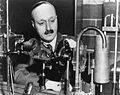
 Prof. Gustav Herz LCCN2014709678
 15. Tagung 1965 Physiker; Maikäferrede- Gustav Hertz, Feodor Lynen - LABW - Staatsarchiv Freiburg W 134 Nr. 078983c
 15. Tagung 1965 Physiker; Maikäferrede- Gustav Hertz, Rudolf L. Mößbauer - LABW - Staatsarchiv Freiburg W 134 Nr. 078989
 15. Tagung 1965 Physiker; Maikäferrede- Gustav Hertz, Rudolf L. Mößbauer - LABW - Staatsarchiv Freiburg W 134 Nr. 078998
 Berliner Physiker u Chemiker 1920
 Gustav Hertz
 2007-03-11 Gedenktafel Hertz
_Gustav_Hertz.jpg?width=1200) Berliner Gedenktafel Fabeckstr 11 (Dahlem) Gustav Hertz
Berliner Gedenktafel Fabeckstr 11 (Dahlem) Gustav HertzAwards
Family
 Gustav Ludwig Hertz
Partners

Is this everyone?
Only relatives with a profile here are drawn, so a family can be larger than this. A line here can also be wrong.
Correct this familyAbout this person
Gustav Ludwig Hertz was born in Germany on 22 July 1887. Working alongside James Franck, he ran experiments that revealed how electrons collide with atoms - and in doing so, confirmed that energy transfer happens in discrete packets, not continuous flows. The work made quantum mechanics something you could measure on a bench, not just argue about on paper. In 1925 the Nobel committee gave them both the prize for discovering the laws that govern what happens when an electron strikes an atom. Hertz died on 30 October 1975, forty years after the prize and a lifetime after the experiment that made his name.



Fame.am measures public visibility signals. It does not measure human value, talent, morality, or credibility.