Gregory Winter
British biochemist (born 1951) · United Kingdom · Scientists
Gregory Winter is read about 39 times a day, in 51 languages.
Counted to 17 September 2026, not since.
The middle day of the days counted, so one week of news cannot move it. The line under it is the last 60 days, one point a day.
Something wrong?Winter solved the problem that kept antibodies from becoming drugs: the human body rejected them because they came from mice. His technique to humanize the molecules opened the floodgates for a generation of cancer and autoimmune therapies, earning him the 2018 Nobel Prize in Chemistry.
A life in dates
Also in Deutsch
Photos 8
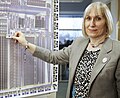
.jpg?width=1200) Gregory Winter, 2016 (cropped)
Gregory Winter, 2016 (cropped).jpg?width=1200) George Smith, Frances Arnold & Greg Winter D81 2556 (45510425004)
George Smith, Frances Arnold & Greg Winter D81 2556 (45510425004).jpg?width=1200) George Smith, Frances Arnold & Greg Winter D81 2557 (45510424004)
George Smith, Frances Arnold & Greg Winter D81 2557 (45510424004).jpg?width=1200) George Smith, Frances Arnold & Greg Winter D81 2560 (44417139060)
George Smith, Frances Arnold & Greg Winter D81 2560 (44417139060).jpg?width=1200) Greg Winter D81 2534 (46234189561)
Greg Winter D81 2534 (46234189561).jpg?width=1200) Greg Winter D81 2536 (46183572082)
Greg Winter D81 2536 (46183572082).jpg?width=1200) Greg Winter EM1B5882 (31295407027)
Greg Winter EM1B5882 (31295407027).jpg?width=1200) Greg Winter EM1B5897 (31295406747)
Greg Winter EM1B5897 (31295406747)Awards
About this person
Gregory Paul Winter was born 14 April 1951 and built his research career almost entirely at the MRC Laboratory of Molecular Biology and the MRC Centre for Protein Engineering in Cambridge. In 1986 he invented techniques to humanize monoclonal antibodies, then refined the method using phage display to create fully human versions - critical because earlier mouse-derived antibodies triggered immune rejection in patients. The breakthrough unlocked therapeutic uses that had been out of reach. For these developments he shared the 2018 Nobel Prize in Chemistry with George Smith and Frances Arnold. He served as Deputy Director of the Laboratory of Molecular Biology from 2006 to 2011, acting Director from 2007 to 2008, and headed the Division of Protein and Nucleic Acids Chemistry from 1994 to 2006. A Fellow of Trinity College, Cambridge, he was appointed Master of Trinity in 2012 and held the post until 2019.
In common with Gregory


Scientists from the United Kingdom 4

Fame.am measures public visibility signals. It does not measure human value, talent, morality, or credibility.