Grace Hopper
American computer scientist and United States Navy officer (1906-1992) · United States · Developers · Died at 85
Grace Hopper is read about 1,416 times a day, in 73 languages.
A typical day, 30 days to 15 October 2026
The middle day of the days counted, so one week of news cannot move it. The line under it is the last 390 days, one point a day.
Something wrong?She taught computers to understand English. Grace Hopper's insight - that programming languages could be built on words instead of raw machine code - laid the groundwork for COBOL and made software legible to generations of people who would never touch a soldering iron.
A life in dates
Also in Deutsch
Photos 8
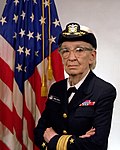
.jpg?width=1200) Commodore Grace M. Hopper, USN (covered)
Commodore Grace M. Hopper, USN (covered).jpg?width=1200) 428-GX-USN 1157762 (25700694682)
428-GX-USN 1157762 (25700694682).jpg?width=1200) 428-GX-USN 1157763 (25700693892)
428-GX-USN 1157763 (25700693892).jpg?width=1200) 428-GX-USN 1157764 (25821649385)
428-GX-USN 1157764 (25821649385).jpg?width=1200) 90-115-AG, AH, Wire Nanosecond (15864510468)
90-115-AG, AH, Wire Nanosecond (15864510468) CCCamp 2019 by CountCrapula 053
 Commodore Grace Hopper, an early computer pioneer
 Commodore Grace M. Hopper, special assistant to the commander, Naval Data Automation Command, speaks during the groundbreaking ceremony for the Grace M. Hopper Navy Regional Data Au - DPLA - 96aa3ef0e8f51e2915d29724177d517e
In their own words 10
 ,
, I had a running compiler and nobody would touch it. ... they carefully told me, computers could only do arithmetic; they could not do programs.
[The Computer] was the first machine man built that assisted the power of his brain instead of the strength of his arm.
There's something you learn in your first boot-camp, or training camp: If they put you down somewhere with nothing to do, go to sleep - you don't know when you'll get any more.
Awards
Family
Parents
Grace HopperPartners
Is this everyone?
Only relatives with a profile here are drawn, so a family can be larger than this. A line here can also be wrong.
Correct this familyAbout this person
Grace Hopper held a Ph.D. in mathematics from Yale and taught at Vassar before leaving academia to join the Navy Reserve in World War II. In 1944 she joined the Harvard Mark I team and wrote what's considered the first computer manual. By 1949 she was at Eckert-Mauchly, working on UNIVAC I and managing compiler development. She finished her A-0 linker in 1952, led the release of FLOW-MATIC in 1954, and in 1959 helped create COBOL through the CODASYL consortium - a machine-independent language built on English terms that she championed through the 1960s. She retired a rear admiral, collected forty honorary degrees, and in 1991 received the National Medal of Technology. A Navy destroyer, a Cray supercomputer, and a college at Yale all carry her name.
Developers from the United States 6





Fame.am measures public visibility signals. It does not measure human value, talent, morality, or credibility.