Georges Clemenceau
Prime Minister of France, 1906-1909 and 1917-1920 (1841-1929) · France · Politicians · Died at 88
Georges Clemenceau is read about 1,410 times a day, in 72 languages.
A typical day, 30 days to 15 October 2026
The middle day of the days counted, so one week of news cannot move it. The line under it is the last 390 days, one point a day.
Something wrong?He dragged France through the last years of the First World War and then sat across from Germany at Versailles, demanding every ounce of restitution the victors could extract. The Tiger didn't want terms; he wanted certainty that 1,400,000 dead French soldiers would never be repeated.
A life in dates
Also in Deutsch
Photos 8
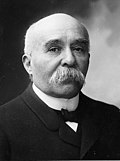
 Georges Clemenceau par Nadar
 111-SC-37780 - NARA - 55234723
 1919-06-28, La Esfera, M. Jorge Clemenceau, presidente del Consejo de Ministros francés, dibujo de Gamonal
 2-10-21, Clémenceau inaugure son monument à Ste Hermine - btv1b53073289h
 2-10-21, Clémenceau inaugure son monument à Ste Hermine - btv1b53073290w
 2-10-21, Clémenceau inaugure son monument à Ste Hermine - btv1b53073291b
 2-10-21, monument de Clémenceau à Ste Hermine - btv1b53073304b
 2-10-21, monument de Clémenceau à Ste Hermine - btv1b53073305s
In their own words 10
 ,
[If the Socialists want peace] so do I, but it is not by bleating of peace that we can silence Prussian militarism. A moment ago M.
Mistakes have been made; do not think of them except to rectify them. Alas, there have also been crimes, crimes against France which call for a prompt punishment.
In the distance huge trees were still blazing, around us was a waste of ashes and of half-consumed boughs, and the falling rain seemed only to quicken the dying conflagration.
Awards
Family
Parents

 Georges Clemenceau
Partners

Children


Brothers and sisters
Is this everyone?
Only relatives with a profile here are drawn, so a family can be larger than this. A line here can also be wrong.
Correct this familyAbout this person
Georges Benjamin Clemenceau was a physician who became a journalist before entering the politics of the Third Republic, where he pushed for separation of church and state and amnesty for exiled Communards. He served as prime minister from 1906 to 1909, then again from 1917 through the war's end in 1920. After more than a million French soldiers died between the German invasion and Armistice, he insisted on total victory: reparations, transferred colonies, disarmament rules, and the return of Alsace-Lorraine, annexed by Germany in 1871. He secured those terms in the Treaty of Versailles at the Paris Peace Conference, earning the nickname Père la Victoire. Through the 1920s he maintained his hard line on Germany, though others thought he hadn't gone far enough. He negotiated mutual defence pacts with Britain and the United States, but the U.S. Senate never ratified, and the treaties collapsed.


Fame.am measures public visibility signals. It does not measure human value, talent, morality, or credibility.