George Berkeley
Irish idealist philosopher and Anglican bishop (1685-1753) · Academics · Died at 67
George Berkeley is read about 719 times a day, in 87 languages.
A typical day, 30 days to 23 October 2026
The middle day of the days counted, so one week of news cannot move it. The line under it is the last 398 days, one point a day.
Something wrong?An 18th-century Irish bishop who said matter doesn't exist - that tables and chairs are ideas in the mind, not stuff in the world - and built a philosophy so strange and tight it still won't go away.
A life in dates
Also in Deutsch
Photos 8
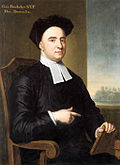
 George Berkeley by Jonh Smibert
 علماء وفلاسفة
 A Treatise Concerning the Principles of Human Knowledge - frontispiece (1904)
 Alciphron 1733 title page Dutch
 Andrea Soldi (c.1703-1771) (circle of) - George Berkeley (1685-1753), Bishop of Cloyne - 38 - Lambeth Palace
 Berkeley p32 diagram
 Berkeley, George - Essays toward a new theory of vision, 1732 - BEIC 11810614
 Berkeley1-1
In their own words 10
 ,
[Tar water] is of a nature so mild and benign and proportioned to the human constitution, as to warm without heating, to cheer but not inebriate.
Truth is the cry of all, but the game of the few.
Westward the course of empire takes its way; The four first acts already past, A fifth shall close the drama with the day: Time's noblest offspring is the last.
Family
George BerkeleyPartners
Children
Is this everyone?
Only relatives with a profile here are drawn, so a family can be larger than this. A line here can also be wrong.
Correct this familyAbout this person
George Berkeley published An Essay Towards a New Theory of Vision in 1709, arguing that sight perceives light and colour, not material objects. A year later came A Treatise Concerning the Principles of Human Knowledge, which flopped, so he rewrote it as Three Dialogues Between Hylas and Philonous in 1713 - a debate where Philonous, "lover of mind," dismantles the case for material substance. He challenged Newton's absolute space and time in De Motu (1721), prefiguring Einstein, then turned to Christian apologetics in Alciphron (1732) and a critique of calculus in The Analyst (1734) that reshaped mathematics. He died in Oxford in 1753 and was buried in Christ Church Cathedral. After World War II, his work on perception and language found new traction, and earlier American fascination had already put his name on a California city and university.
Academics born in the 1680s 6


Fame.am measures public visibility signals. It does not measure human value, talent, morality, or credibility.