George Beadle
American geneticist (1903-1989) · United States · Academics · Died at 85
George Beadle is read about 51 times a day, in 57 languages.
A typical day, 30 days to 22 September 2026
The middle day of the days counted, so one week of news cannot move it. The line under it is the last 60 days, one point a day.
Something wrong?He irradiated bread mold and cracked the code between genes and chemistry. The "one gene-one enzyme" hypothesis - born in a lab full of mutant Neurospora - earned George Beadle half a Nobel and rewrote how we understand what genes actually do.
A life in dates
Also in Deutsch
Photos 3
.jpg?width=1200)


In their own words 1
 ,
, Ionizing radiation has always been with us and will be for all foreseeable time. Our genetic system is probably well adjusted by natural selection to normal background radiation.
Awards
In their orbit
About this person
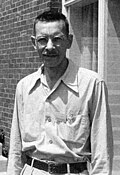
George Wells Beadle was born October 22, 1903, an American geneticist who would spend years staring at fungus under controlled mutation. Working with Edward Tatum, he exposed the bread mold Neurospora crassa to x-rays, inducing mutations, then traced how each genetic break disrupted a specific enzyme in the cell's metabolic assembly line. The experiments were elegant and relentless: one mutation, one missing enzyme, one broken chemical step. In 1958 the work won him half the Nobel Prize in Physiology or Medicine for demonstrating that genes directly govern biochemical events inside cells - the "one gene-one enzyme hypothesis" that bridged genetics and biochemistry. He later served as president of the University of Chicago from 1961 to 1968. Beadle died June 9, 1989, decades after the mold experiments that turned inheritance into a readable chemical language.
In common with George
 Alfred HersheyBoth received Kimber Genetics Award
 Oliver SmithiesBoth received Thomas Hunt Morgan Medal
 Richard LewontinBoth received Thomas Hunt Morgan Medal
 Sewall WrightBoth received Kimber Genetics Award
 Theodosius DobzhanskyBoth received Kimber Genetics Award
 Edward B. LewisBoth received Thomas Hunt Morgan Medal
Fame.am measures public visibility signals. It does not measure human value, talent, morality, or credibility.