Georg Simmel
German sociologist, philosopher, and critic (1858-1918) · Academics · Died at 60
Georg Simmel is read about 498 times a day, in 52 languages.
A typical day, 30 days to 21 October 2026
The middle day of the days counted, so one week of news cannot move it. The line under it is the last 396 days, one point a day.
Something wrong?He asked "What is society?" the way Kant asked "What is nature?" - and helped invent sociology by treating the modern city, the stranger, even romantic love as structures you could map like geometry.
A life in dates
Also in Deutsch
Photos 8


_Georg_Simmel.jpg?width=1200)


In their own words 10
 ,
, The social game has a deeper double meaning - that it is played not only in a society as its outward bearer but that with its help people actually "play" "society.
Objectivity does not simply involve passivity and detachment; it is a particular structure composed of distance and nearness, indifference and involvement.
All relationships of people to each other rest, as a matter of course, upon the precondition that they know something about each other.
Family
Parents
Georg SimmelPartners

Is this everyone?
Only relatives with a profile here are drawn, so a family can be larger than this. A line here can also be wrong.
Correct this familyAbout this person
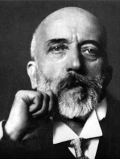
Georg Simmel was born 1 March 1858 in Germany and became a philosopher and sociologist who rejected the positivist mainstream. His neo-Kantian method analyzed social life as shifting "forms" and "contents" - a pattern could be structure in one context, substance in another - prefiguring structuralism decades early. He wrote "The Metropolis and Mental Life," laying ground for urban sociology, symbolic interactionism, and social network analysis. An acquaintance of Max Weber, he covered emotion, romantic love, and the fragmentation of the individual with the same rigor others reserved for institutions. Both men's nonpositivist work fed the Frankfurt School's critical theory. Simmel died 26 September 1918, having built a sociology that treated feeling and form as equal weights on the same scale.




Fame.am measures public visibility signals. It does not measure human value, talent, morality, or credibility.