Fumimaro Konoe
Politician and former Prime Minister of Japan (1891-1945) · Japan · On the map · Politicians · Died at 54
He presided over Japan's invasion of China in 1937 and the collapse of relations with the United States that led to the Pacific War.
Fumimaro Konoe is read about 1,471 times a day, in 46 languages.
A typical day, 30 days to 6 November 2026
The middle day of the days counted, so one week of news cannot move it. The line under it is the last 400 days, one point a day.
Something wrong?People around Fumimaro


Parents

 Fumimaro Konoe
Partners

Children

Brothers and sisters


Is this everyone?
Only relatives with a profile here are drawn, so a family can be larger than this. A line here can also be wrong. A marriage is drawn as ended only where its end is recorded, so a spouse drawn here may be a former one.
Correct this familyAlso in Deutsch
Media & music
Photos 12

 Konoe reading imperial rescript as president of the House of Peers, 1936

 Konoe and his first cabinet ministers in 1937
 Japanese propaganda postcard published in 1938 for promoting alliance with Nazi Germany and Fascist Italy, with saying "Friendly Three Countries" and photos of Adolf Hitler, Fumimaro Konoe and Benito Mussolini
 Prime Minister Kiichirō Hiranuma (1867-1952, in office January-August 1939, center, front row) and the members of his cabinet, including Minister-without-Portfolio Fumimaro Konoe (to the right of Hiranuma), Interior Minister Kōichi Kido (second row, between Hiranuma and Konoe), Naval Minister Mitsumasa Yonai (back row, with dark military suit) and War Minister Seishirō Itagaki (to the right of Yonai, with light military suit), on the inaugural day of his administration
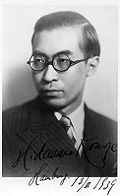
 Prime Minister Fumimaro Konoe (1891-1945, in office 1937-39 and 1940-41)
Awards
About this person
Born in Tokyo to a prominent aristocratic family, Konoe graduated from Kyoto University and inherited his father's seat in the House of Peers in 1916. He attended the Paris Peace Conference after World War I and became president of the House of Peers in 1933. When he took office as prime minister in June 1937, the Marco Polo Bridge Incident erupted a month later - he escalated the crisis into full war with China. His government oversaw early victories and atrocities including the Nanjing Massacre, then enacted the State General Mobilization Law in 1938 to regiment civilian life for total war. Unable to force a decision in China, he resigned in January 1939. Appointed prime minister again in July 1940, he founded the Imperial Rule Assistance Association, signed the Tripartite Pact, invaded French Indochina, and recognized Wang Jingwei's puppet regime in Nanjing. His attempt to negotiate with Washington failed under military deadlines and his own rigidity. He resigned in October 1941, six weeks before Pearl Harbor.